
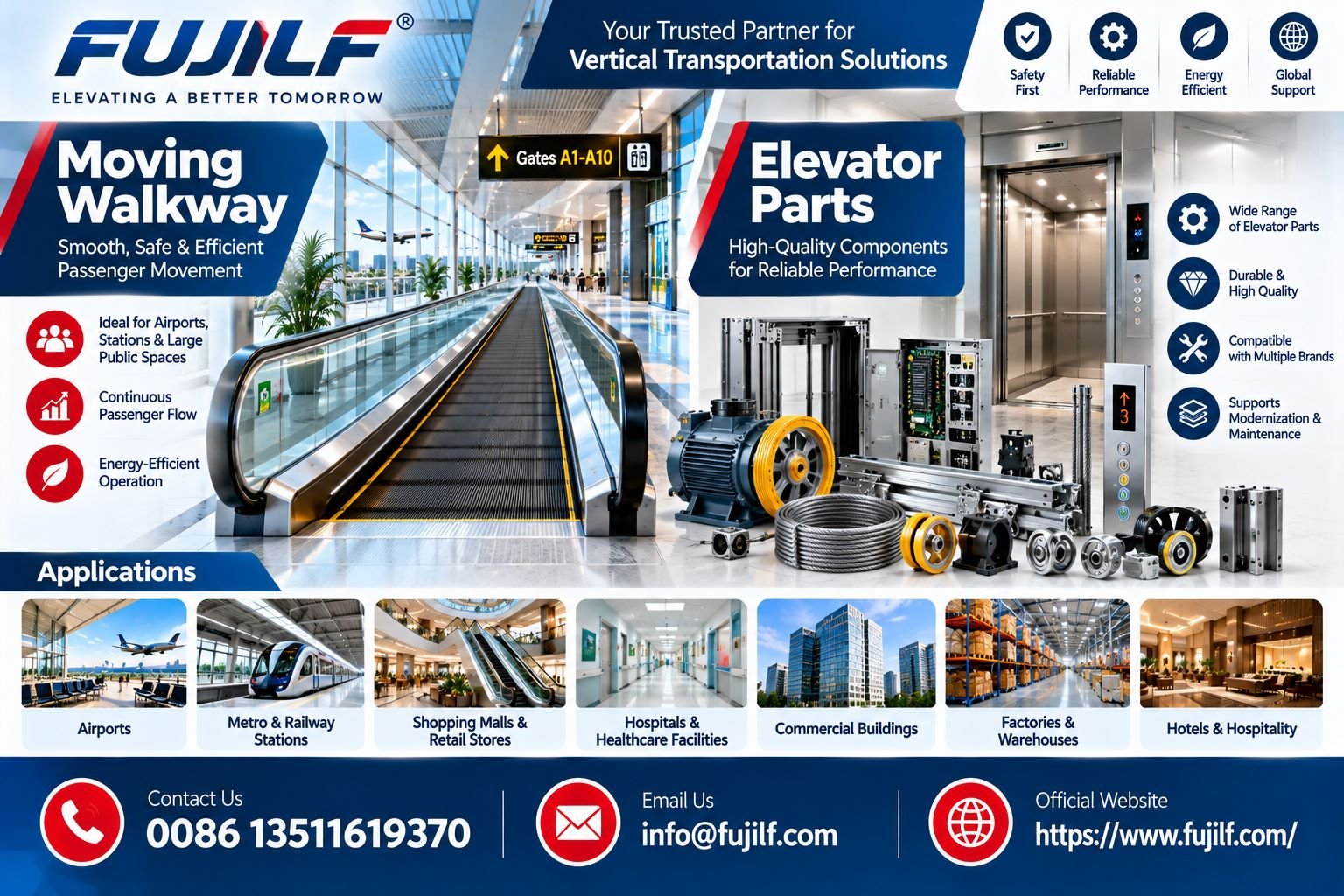
Airports, railway stations, metro interchanges, and large transportation terminals require carefully organized passenger movement. These facilities often connect platforms, security checkpoints, waiting areas, parking facilities, and commercial zones across extensive building layouts.
A moving walkway supports passenger movement through long corridors and transfer routes, reducing the physical effort associated with travelling across large terminals.
Meanwhile, reliable elevator parts help maintain the performance of elevators connecting different building levels.
Although these systems perform separate functions, they contribute to the wider objective of providing accessible and convenient transportation infrastructure.
The growing emphasis on integrated mobility encourages facility developers to examine how horizontal and vertical transportation systems work together.
The objective is not simply to install additional equipment but to create a passenger journey that remains convenient from one facility zone to another.
Why Seamless Passenger Transfers Matter
Large transport hubs frequently require passengers to move between different transportation modes.
An airport visitor may travel from a parking structure to a terminal entrance before accessing departure facilities.
Similarly, a railway passenger may need to move between an underground platform, a connecting corridor, and a station exit.
These journeys can become physically demanding when facilities are spread across different levels and considerable distances.
A properly positioned moving walkway can improve convenience along suitable pedestrian routes.
Elevators provide an important connection where vertical access is required.
A transportation design principle explains:
This highlights the importance of planning routes as complete journeys rather than separate infrastructure components.
Moving Walkway Placement Influences Terminal Connectivity
The location of a moving walkway can influence how passengers experience a large transportation facility.
Equipment placed along frequently used corridors may support easier movement between major destinations.
However, installation decisions require an understanding of pedestrian circulation, surrounding space, and accessibility requirements.
Important planning factors include:
- Transfer routes: Identifying corridors connecting important passenger destinations.
- Passenger circulation: Understanding how travellers approach and leave equipment.
- Luggage movement: Considering passengers carrying approved bags and personal belongings.
- Alternative pathways: Maintaining suitable walking routes and accessible alternatives.
- Equipment capacity: Selecting systems appropriate for intended passenger demand.
A moving walkway must also provide appropriate approaches and exits according to its approved design.
Good placement can support convenience, while poor positioning may create congestion or unnecessary detours.
Elevator Parts Support Vertical Connections Across Transport Facilities
Large transportation terminals often contain multiple building levels.
Elevators connect areas such as platforms, ticketing halls, parking structures, and passenger facilities.
Their dependable operation depends on compatible mechanical, electrical, and electronic components.
Properly specified elevator parts support functions involving door movement, car positioning, drive operation, and equipment controls.
Relevant component categories include:
Door Operating Components
Door mechanisms support controlled passenger entry and exit. Their correct operation is particularly important in facilities accommodating passengers with luggage or mobility aids.
Control Systems
Elevator controllers coordinate approved operating functions and help manage movement between designated levels.
Positioning and Leveling Components
Suitable positioning arrangements support accurate stopping and accessible movement between elevator cabins and landings.
Safety Equipment
Protective components perform essential functions according to the elevator’s approved design and applicable technical requirements.
Replacement components must be verified for compatibility with the specific installation.
Designing Transport Facilities for Passengers With Luggage
Passengers travelling through airports and railway terminals often carry suitcases, backpacks, and other personal belongings.
This creates mobility requirements that differ from those of many conventional commercial buildings.
A moving walkway may make suitable long-distance transfers more convenient for travellers carrying luggage.
However, passenger guidance must follow the equipment manufacturer’s operating instructions.
Some luggage-handling arrangements may be unsuitable for particular walkway configurations.
Elevators also require consideration of cabin space, doorway dimensions, and rated capacity.
Terminal designers should account for the movement of passengers with permitted luggage while preserving safe and accessible circulation.
Transportation planning should reflect actual user needs rather than relying exclusively on general equipment specifications.
Accessibility Requires a Connected Mobility Network
Accessible transportation involves more than installing an elevator at a particular location.
Passengers must be able to reach accessible equipment through suitable routes.
A station may contain functioning elevators yet remain difficult to navigate if their entrances are poorly connected to important passenger destinations.
Effective planning should therefore examine the entire accessible journey.
Relevant considerations include clearly identified routes, appropriate elevator dimensions, accessible controls, and understandable directional information.
A practical infrastructure observation states:
Moving walkways may provide convenience for some travellers, but they are not substitutes for required accessible routes.
The availability of suitable alternatives remains essential.
Coordinating Equipment Selection Across Different Transport Zones
Transport facilities may contain equipment from different manufacturers or technical configurations.
For building owners, this makes accurate documentation and component identification important.
When purchasing elevator parts, maintenance teams should confirm the relevant model, approved specifications, and installation requirements.
Components should not be selected solely because they appear similar to existing equipment.
Moving walkway installations require the same level of attention to approved equipment specifications and appropriate technical support.
A structured equipment register can help facility managers identify installations, maintain technical documentation, and coordinate authorized servicing.
This supports clearer infrastructure management across complex transport facilities.
Passenger Communication Complements Physical Infrastructure
Convenient mobility depends on understandable information as well as transportation equipment.
Passengers should be able to locate moving walkways, elevators, platforms, and terminal facilities without unnecessary confusion.
Appropriate signs, floor directories, and accessible information systems can support this objective.
Facility operators should also provide clear guidance when a route or piece of equipment becomes unavailable.
Alternative pathways must be identified according to the building’s accessibility and operational requirements.
The result is a more coordinated approach in which equipment, architecture, and passenger information support one another.
Future Direction: Designing Complete Passenger Journeys
Transportation infrastructure planning benefits from viewing horizontal and vertical movement as interconnected requirements.
Moving walkways can improve convenience across selected terminal corridors, while dependable elevators connect essential building levels.
Compatible components, suitable equipment placement, and accessible route planning all contribute to effective passenger movement.
For developers, the important opportunity lies in coordinating these systems within a unified building transportation strategy.
Such planning supports clearer circulation, more practical infrastructure management, and a more comfortable passenger experience.
Frequently Asked Questions (FAQs)
1. What is a moving walkway used for in airports?
A moving walkway helps passengers travel along suitable horizontal or gently inclined routes. It is commonly used to connect terminal corridors, transportation facilities, and other passenger areas.
2. Why are elevator parts important in railway stations?
Reliable elevator parts support the functioning of elevators connecting platforms, entrances, parking facilities, and other station levels. Compatible components help maintain appropriate operating performance.
3. Can passengers carry luggage on moving walkways?
Passengers may carry permitted luggage according to the walkway’s design and operating instructions. Restrictions and passenger guidance should be followed.
4. How do elevators improve transport hub accessibility?
Elevators provide step-free transportation between building levels and can support passengers using mobility aids, travelling with luggage, or requiring accessible routes.
5. What should transport facility operators consider when selecting elevator replacement parts?
Operators should verify equipment compatibility, approved technical specifications, manufacturer documentation, applicable safety requirements, and qualified installation support.
Media Contact
Department: Business Enquiries & Vertical Transportation Solutions
Industry: Moving Walkways, Elevators, Escalators & Elevator Components
Contact: 008613511619370
Email: info@fujilf.com
Official Website: https://www.fujilf.com/