
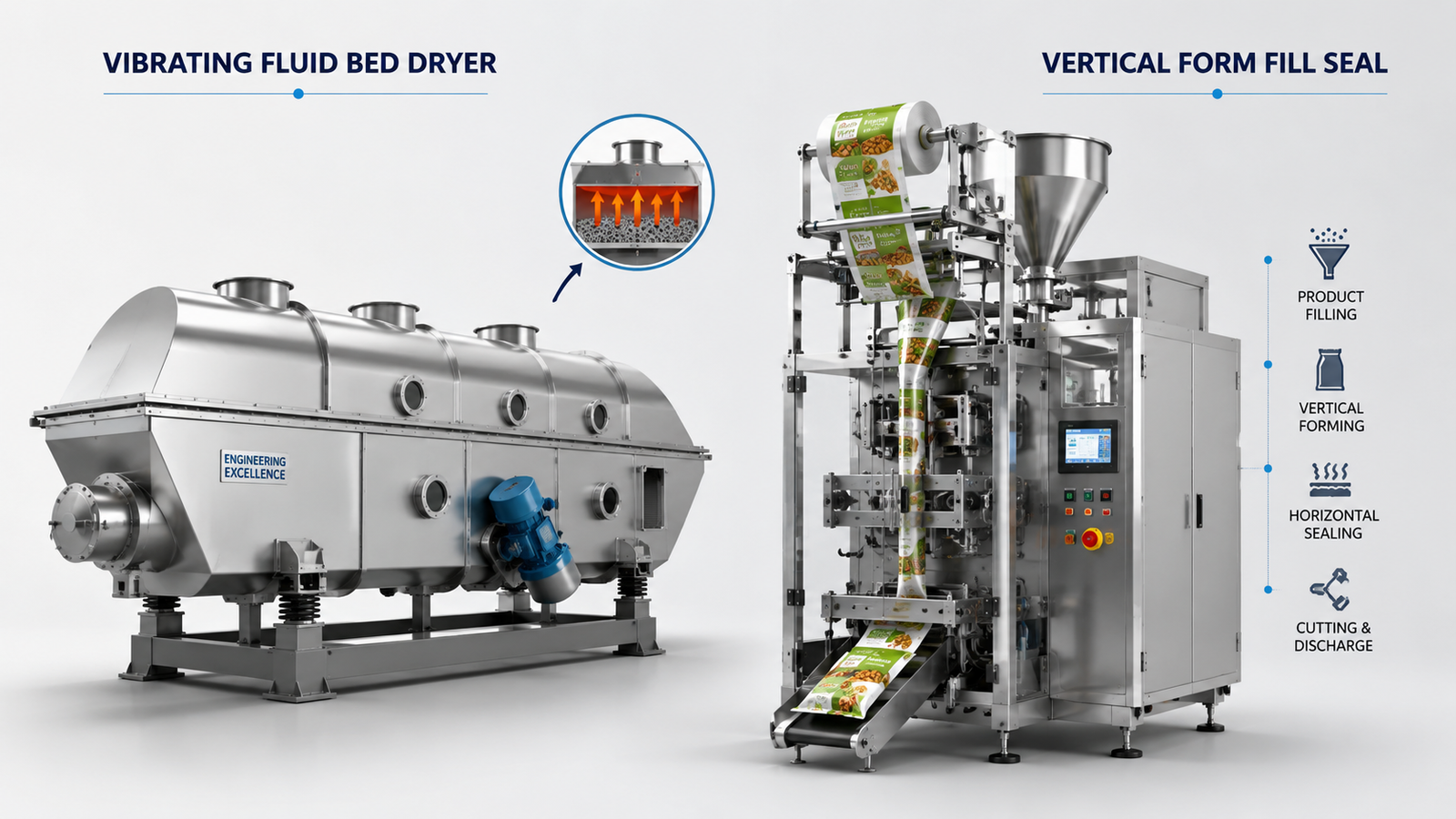
Industrial manufacturing increasingly depends on equipment that can improve product consistency, reduce handling, and support faster production. Two technologies that play important roles in modern processing and packaging lines are the vibrating fluid bed dryer and vertical form fill seal machine. Although these systems perform very different functions, they can become complementary parts of an integrated production process.
A vibrating fluid bed dryer is primarily designed for controlled drying, cooling, or conditioning of granular and particulate materials. A vertical form fill seal system, commonly known as VFFS, automatically forms packaging material into bags, fills them with product, and seals the finished packages.
Industries such as food processing, chemicals, pharmaceuticals, agricultural products, minerals, and nutraceuticals can benefit significantly from understanding how these technologies work and where they fit within a production line.
What Is a Vibrating Fluid Bed Dryer?
A vibrating fluid bed dryer is industrial processing equipment used to remove moisture from powders, crystals, granules, pellets, and other free-flowing materials.
The product travels across a perforated processing deck while controlled air passes upward through the material. Mechanical vibration helps transport the product evenly through the machine while improving contact between the process air and individual particles.
This combination of vibration and fluidisation encourages consistent heat transfer.
Instead of allowing material to remain stationary during drying, the vibrating motion helps distribute the product across the drying surface, reducing uneven processing.
Typical applications include:
- Food ingredients
- Sugar and salt
- Chemical granules
- Fertiliser products
- Pharmaceutical ingredients
- Plastic pellets
- Minerals
- Animal feed products
- Seeds and agricultural materials
The equipment can also be configured for cooling after thermal processing.
How Does a Vibrating Fluid Bed Dryer Work?
Material enters the drying chamber and spreads across a perforated deck. Heated process air moves through openings beneath the material.
At the same time, controlled mechanical vibration moves the product forward.
The process generally involves four stages:
- Material enters the processing section.
- Heated air fluidises and dries the particles.
- Vibration controls material movement and residence time.
- Conditioned material exits for further processing or packaging.
Air temperature, airflow, vibration frequency, material depth, and residence time can be adjusted according to the product.
Proper adjustment is important because moisture levels, particle size, bulk density, and heat sensitivity vary significantly between materials.
Key Advantages of Vibrating Fluid Bed Drying
One major benefit of this technology is uniform product treatment.
Because vibration continuously distributes materials through the processing zone, manufacturers can achieve more controlled drying compared with poorly mixed static systems.
Other potential advantages include:
- Consistent moisture removal
- Improved heat-transfer efficiency
- Controlled residence time
- Continuous material movement
- Reduced particle agglomeration
- Drying and cooling possibilities
- Suitable operation for various granular products
- Integration with automated production systems
For sensitive materials, carefully controlled processing conditions may also help maintain desirable product characteristics.
What Is Vertical Form Fill Seal Technology?
A vertical form fill seal machine is automatic packaging equipment that creates bags from flexible packaging film while simultaneously filling and sealing the package.
Film is supplied from a roll and guided around a forming tube. The machine creates a vertical seal to form the packaging material into a tube. A horizontal seal creates the bottom of the package before the required amount of product is dispensed.
After filling, another horizontal seal closes the package and simultaneously prepares the next bag.
VFFS technology is commonly used for:
- Snacks
- Coffee
- Rice
- Sugar
- Spices
- Pulses
- Frozen foods
- Confectionery
- Powders
- Granules
- Pet foods
- Agricultural products
Different filling systems can be integrated depending on product characteristics.
How Vertical Form Fill Seal Machines Operate
The packaging cycle begins when flexible film unwinds from a reel.
The basic sequence includes:
- Film is pulled into the machine.
- A forming collar shapes the film around a tube.
- A vertical sealing mechanism creates the longitudinal seal.
- Horizontal sealing jaws create the bottom seal.
- Product enters the package through the forming tube.
- The sealing jaws close the top.
- The finished package is cut and discharged.
Modern vertical form fill seal systems can incorporate sensors, weighing systems, date coding, inspection devices, and automatic controls.
Choosing the Right Filling System
The correct dosing technology depends on the product being packaged.
For free-flowing granular products, multihead weighing or volumetric filling systems may be suitable.
Powders may require auger fillers that provide controlled dosing.
Liquid or semi-liquid products generally require pumps designed specifically for their viscosity and handling requirements.
Understanding product behaviour is essential before selecting a VFFS configuration.
Vibrating Fluid Bed Dryer vs Vertical Form Fill Seal
| Feature | Vibrating Fluid Bed Dryer | Vertical Form Fill Seal |
| Primary function | Drying and conditioning | Packaging |
| Processing stage | Production | Final packaging |
| Common materials | Powders and granules | Powders, granules, liquids and solids |
| Main technology | Fluidisation and vibration | Film forming, filling and sealing |
| Key objective | Moisture and temperature control | Automated package creation |
| Automation potential | High | High |
These machines are not alternatives. They perform separate functions that can be connected within one manufacturing system.
Integrating Drying and Packaging Equipment
A processing facility may use a vibrating fluid bed dryer before a vertical form fill seal machine.
For example, granular food ingredients can first be dried to the required moisture level. The material may then pass through cooling, screening, inspection, weighing, and packaging stages.
A typical production flow could be:
Raw material → Processing → Fluid bed drying → Cooling → Screening → Weighing → VFFS packaging → Inspection → Finished product
Automation between these stages can reduce manual handling.
Factors to Consider When Selecting Equipment
Manufacturers should evaluate equipment according to the complete production requirement rather than focusing only on machine capacity.
Important considerations include:
- Product characteristics
- Required throughput
- Moisture content
- Target final moisture
- Particle size
- Heat sensitivity
- Package weight
- Film compatibility
- Cleaning requirements
- Automation level
- Available floor space
- Maintenance accessibility
Testing actual product samples can provide valuable information before final equipment selection.
Improving Production Efficiency
Efficiency depends on more than installing high-capacity machinery.
Manufacturers should optimise airflow and drying parameters in the fluid bed while ensuring accurate product feeding into packaging equipment.
Consistent upstream processing helps packaging machines operate more reliably.
Routine inspection of screens, air systems, vibration components, sealing jaws, heaters, sensors, belts, and film handling systems can also reduce unexpected downtime.
FAQs
1. What is a vibrating fluid bed dryer used for?
It is used for controlled drying, cooling, and conditioning of granular or particulate materials.
2. Why is vibration used in fluid bed drying?
Vibration helps move materials consistently through the dryer while encouraging uniform product distribution.
3. Can a fluid bed dryer handle powders?
Yes, although suitability depends on particle characteristics, dust behaviour, and equipment configuration.
4. What does vertical form fill seal mean?
It refers to a packaging process where film is vertically formed into bags, filled with product, and automatically sealed.
5. Can VFFS machines package powders?
Yes. They can work with auger fillers designed for powders.
6. Can VFFS machines package granules?
Yes. Granules are commonly packaged using weighing or volumetric filling systems.
7. Can drying and packaging equipment be connected?
Yes. Automated conveyors and product-handling systems can integrate multiple production stages.
8. What industries use fluid bed dryers?
Food, chemical, pharmaceutical, agricultural, mineral, plastic, and related processing industries use them.
9. What packaging materials can VFFS equipment use?
Compatibility depends on machine design, but many flexible laminated and heat-sealable films can be processed.
10. How do manufacturers choose suitable equipment?
They should evaluate product properties, processing requirements, capacity, automation needs, hygiene standards, and future production goals.