
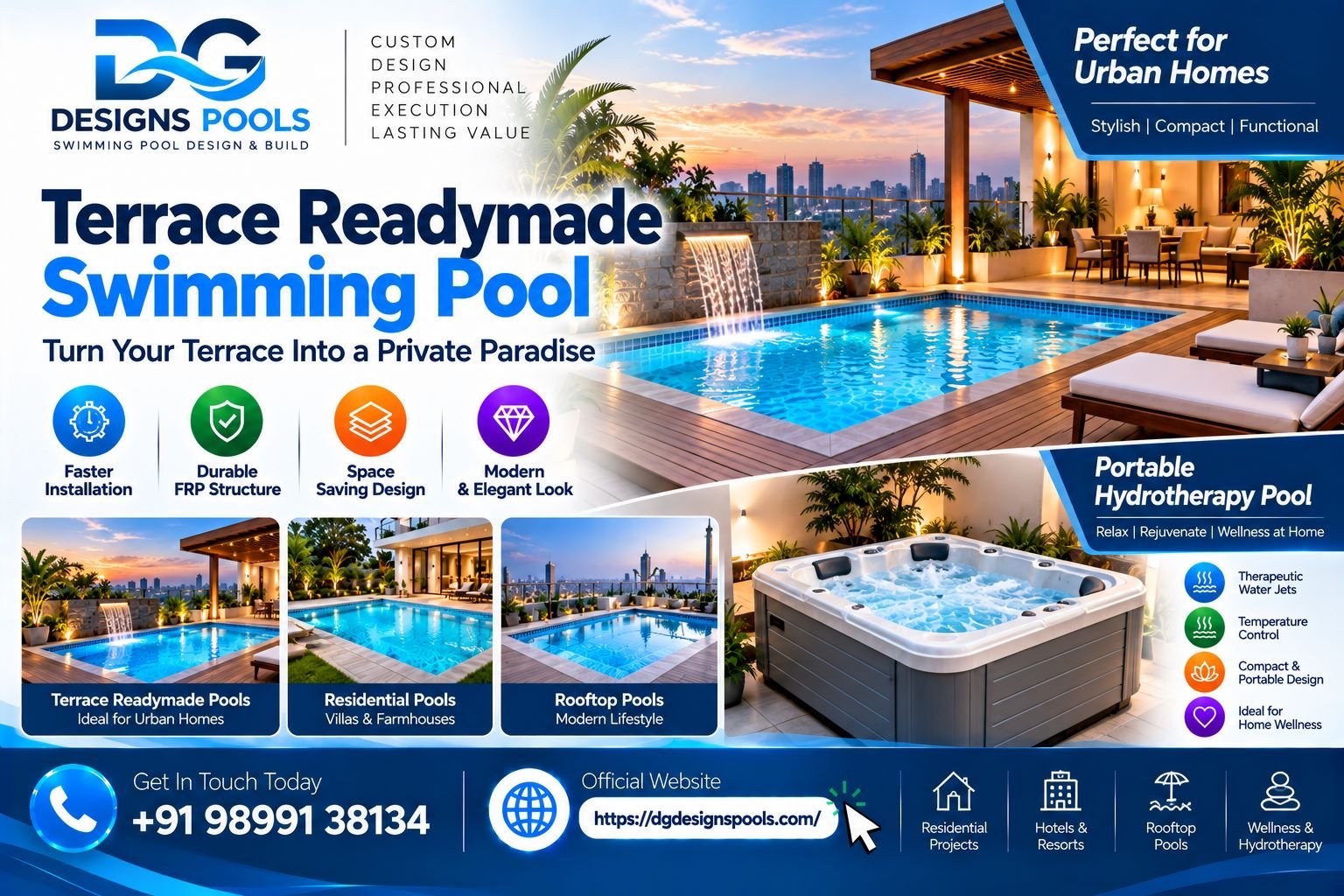
As modern homeowners explore new ways to create comfortable outdoor spaces, compact swimming pools and wellness-focused aquatic installations are becoming increasingly relevant to residential design discussions.
A terrace readymade swimming pool offers an option for transforming suitable rooftop spaces into private recreational areas, while a portable hydrotherapy pool provides a compact water-based relaxation or therapeutic exercise environment, depending on its design and intended use.
Both solutions require careful consideration of structural safety, installation requirements, water treatment, maintenance, and operating costs.
For homeowners, architects, hospitality businesses, and property developers, understanding these factors is essential before investing in residential aquatic facilities.
What Is a Terrace Readymade Swimming Pool?
A terrace readymade swimming pool is a prefabricated swimming pool structure designed for installation on a suitable terrace or rooftop.
Unlike conventional swimming pools built below ground level, terrace pools are installed on elevated building structures.
Depending on the design, these pools may use fiberglass-reinforced plastic, modular panels, or other engineered construction materials.
Key Features of Terrace Swimming Pools
- Prefabricated Construction: Major components are manufactured before installation.
- Space Optimization: Compact designs may suit selected rooftop areas.
- Customization: Pool dimensions and finishes can be adapted within engineering limitations.
- Modern Appearance: Pools can complement contemporary architectural designs.
- Recreational Use: Provides a private space for relaxation and water-based activities.
- Equipment Integration: Suitable systems incorporate circulation, filtration, and water treatment.
Why Terrace Swimming Pools Require Structural Planning
Rooftop swimming pools introduce substantial loads to a building.
One cubic metre of water weighs approximately 1,000 kilograms. A pool containing 10 cubic metres of water therefore holds approximately 10 tonnes of water alone.
The complete structural assessment must also consider the pool shell, occupants, equipment, and other applicable loads.
Essential Engineering Considerations
Load-Bearing Capacity: Structural engineers must assess whether the building can safely support the installation.
Waterproofing: Protective systems should prevent leakage into occupied areas.
Drainage: Overflow and maintenance drainage must be planned.
Access: Transportation and lifting arrangements must accommodate the proposed pool.
Building Approvals: Applicable local permissions and structural requirements should be reviewed.
Electrical Safety: Equipment installation must account for wet environments.
A prefabricated pool should never be installed on an existing terrace without qualified structural engineering approval.
Understanding Portable Hydrotherapy Pools
A portable hydrotherapy pool is a movable or prefabricated aquatic unit designed to support suitable water-based relaxation, exercise, or therapeutic activities.
Depending on its configuration, it may include temperature controls, water jets, seating, and circulation systems.
Some units resemble compact spas, while others provide additional space for supervised aquatic exercise.
Common Features
- Temperature Regulation: Certain models allow controlled water heating.
- Hydrotherapy Jets: Selected units use water movement for massage-like effects.
- Compact Design: Suitable models may occupy less space than conventional pools.
- Seating Options: Integrated seating can improve comfort.
- Filtration Systems: Appropriate equipment supports water circulation.
- Installation Flexibility: Some units can be relocated, subject to handling and structural requirements.
Portability does not mean a filled unit can be moved safely or placed on any surface.
Benefits of Hydrotherapy Pool Systems
Water-based activities can provide a comfortable environment for certain forms of exercise and relaxation.
Buoyancy reduces effective weight-bearing during immersion, which may make some movements easier.
Warm water may promote temporary relaxation and comfort for suitable users.
However, a portable hydrotherapy pool should not be presented as a guaranteed treatment for medical conditions.
People with cardiovascular concerns, mobility limitations, pregnancy-related risks, or other relevant health conditions should seek professional medical guidance before using heated therapeutic pools.
Terrace Swimming Pool vs. Portable Hydrotherapy Pool
| Feature | Terrace Readymade Pool | Portable Hydrotherapy Pool |
| Primary purpose | Recreation and swimming | Relaxation or suitable aquatic activity |
| Size | Varies by design | Often compact |
| Installation | Requires engineered rooftop support | Requires a suitably rated support surface |
| Common features | Steps, filtration, decorative finishes | Jets, seating, temperature controls |
| Mobility | Generally fixed after installation | Some models are relocatable when empty |
| Main consideration | Structural loading and waterproofing | Safety, hygiene, heating, and support capacity |
The appropriate choice depends on available space, user requirements, and installation feasibility.
Materials Used in Prefabricated Aquatic Systems
Material selection influences performance, appearance, and maintenance.
Fiberglass Reinforced Plastic
FRP combines fiberglass reinforcement with polymer resin to create lightweight composite structures relative to some traditional construction systems.
Acrylic Materials
Certain compact spa units use acrylic surfaces supported by suitable structural components.
Modular Panel Systems
Engineered panel systems can offer flexibility in transportation and assembly.
Surface Finishes
Suitable coatings and finishes contribute to appearance, cleaning convenience, and resistance to expected water conditions.
Each material must be evaluated for its intended temperature, chemical exposure, and structural application.
Water Treatment and Maintenance Requirements
Both rooftop pools and hydrotherapy systems require consistent water treatment.
Important maintenance activities include:
- Testing disinfectant concentration and pH.
- Cleaning filters and circulation components.
- Inspecting fittings and connections for leakage.
- Monitoring heating equipment where installed.
- Cleaning accessible surfaces.
- Following appropriate water replacement procedures.
- Checking waterproofing and drainage arrangements.
Warm hydrotherapy water can increase the importance of hygiene management because elevated temperatures may encourage microbial growth when disinfection is inadequate.
Proper operation should follow the equipment manufacturer’s guidance and applicable public-health requirements.
Choosing the Right Pool for a Residential Property
Before purchasing a terrace readymade swimming pool, homeowners should assess the available area, structural condition, intended use, and maintenance budget.
For hydrotherapy installations, additional considerations include water temperature, accessibility, user mobility, energy consumption, and sanitation requirements.
A professional supplier should provide clear technical specifications, installation guidance, equipment details, and warranty information.
The final decision should prioritize safety and long-term suitability rather than appearance alone.
Frequently Asked Questions (FAQs)
1. What is a terrace readymade swimming pool?
It is a prefabricated pool structure intended for installation on a suitable rooftop or terrace.
2. Can a readymade swimming pool be installed on any terrace?
No. Installation requires structural assessment and approval from qualified professionals.
3. What is a portable hydrotherapy pool?
It is a prefabricated aquatic unit designed for suitable relaxation, water-based exercise, or therapeutic applications.
4. Are portable hydrotherapy pools suitable for home use?
Yes, provided the selected unit, installation conditions, and user requirements are appropriate.
5. Are fiberglass pools suitable for terraces?
Some engineered fiberglass systems may be suitable, but structural compatibility must be verified.
6. Do hydrotherapy pools need heating systems?
Not always. Heating requirements depend on the unit’s design and intended use.
7. What affects the cost of a terrace swimming pool?
Size, structural work, materials, lifting, waterproofing, and filtration equipment influence costs.
8. Are portable hydrotherapy pools easy to maintain?
Maintenance requirements vary, but regular cleaning, disinfection, and equipment inspection are essential.
9. Can hydrotherapy pools help with physical rehabilitation?
Water-based exercise may support certain rehabilitation programmes when recommended and supervised by qualified healthcare professionals.
10. How should homeowners select a pool manufacturer?
Evaluate engineering support, product specifications, installation experience, quality standards, warranty terms, and maintenance services.
Media Contact
Department: Swimming Pool Design and Business Communications
Email: abhinav.mishra@hotmail.com
Contact: +91 98991 38134
Official Website: https://dgdesignspools.com/