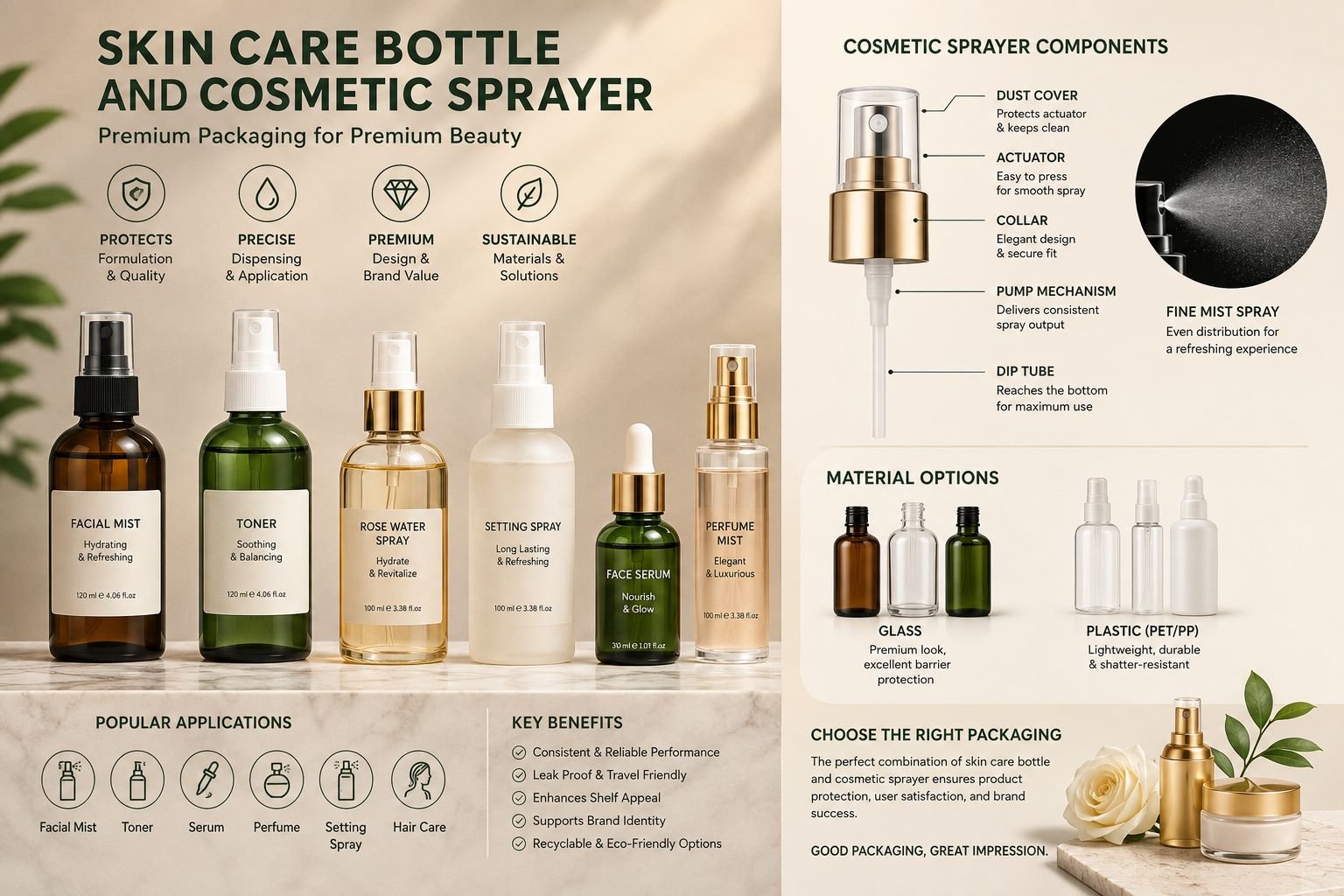
In the beauty and personal care industry, packaging does much more than hold a formula. It protects the product, influences how conveniently customers use it, supports brand positioning, and helps create a memorable experience. Two important packaging solutions used across skincare and cosmetic ranges are the skin care bottle and cosmetic sprayer.
From facial serums and moisturising lotions to toners, body mists, and setting sprays, choosing the appropriate packaging system can affect product stability, dosage control, appearance, and customer satisfaction. Brands therefore need to evaluate materials, dispensing mechanisms, compatibility, sustainability, and design before selecting packaging.
What Is a Skin Care Bottle?
A skin care bottle is a packaging container designed for cosmetic and personal care formulations such as lotions, serums, cleansers, oils, toners, essences, and moisturisers.
These bottles are manufactured in different capacities, materials, shapes, colours, and neck configurations. Depending on the formulation, they may be combined with pumps, droppers, caps, or sprayers.
Common materials include PET, PETG, HDPE, PP, glass, and other cosmetic-grade packaging materials. The ideal material depends on formula compatibility, desired appearance, transportation requirements, cost, and sustainability objectives.
Why Skin Care Bottle Selection Matters
Packaging is the point where formulation protection and customer experience meet. A carefully selected skin care bottle helps reduce unnecessary product exposure while allowing consumers to dispense an appropriate quantity.
Important considerations include:
- Compatibility between packaging and formulation
- Protection against contamination and leakage
- Convenient and controlled dispensing
- Attractive shelf presentation
- Resistance to transportation damage
- Suitable capacity and dimensions
- Opportunities for branding and decoration
For light-sensitive formulations, tinted or opaque packaging may provide additional protection. Similarly, products that should have limited contact with air may benefit from pump-based or airless packaging systems.
What Is a Cosmetic Sprayer?
A cosmetic sprayer is a dispensing component designed to transform a liquid cosmetic formulation into a controlled spray or mist. It is commonly installed on bottles containing facial mist, toner, body spray, hair care liquid, fragrance mist, setting spray, or refreshing skincare products.
The quality of a cosmetic sprayer influences spray distribution, application consistency, leakage resistance, and the overall feel of the product.
A fine-mist design is frequently selected when customers need smooth, broad application rather than a concentrated stream of liquid.
How a Cosmetic Sprayer Works
A typical sprayer includes an actuator, pump mechanism, dip tube, closure, and nozzle. When the actuator is pressed, the pump draws liquid through the dip tube and directs it through the nozzle.
The nozzle design determines how the product exits.
A well-designed cosmetic sprayer should provide predictable dispensing from one application to another. However, performance needs to be tested with the actual formula because viscosity, ingredients, and packaging dimensions can influence spray behaviour.
Skin Care Bottle vs Cosmetic Sprayer
Although they are closely connected, a bottle and sprayer perform different packaging functions.
| Feature | Skin Care Bottle | Cosmetic Sprayer |
| Primary role | Stores and protects formulation | Dispenses liquid formulation |
| Typical products | Serum, lotion, cleanser, oil | Mist, toner, setting spray |
| Material options | Plastic or glass | Primarily plastic components |
| Customisation | Shape, colour, print, capacity | Closure, actuator, spray pattern |
| Main consideration | Formula protection | Dispensing performance |
In many products, both components work together. The bottle provides storage while the cosmetic sprayer controls application.
Choosing the Right Skin Care Bottle
Brands should evaluate packaging according to the actual characteristics of their formula rather than appearance alone.
1. Consider the Product Formula
Viscosity is important. Thin liquids may work effectively with sprayers, while thicker creams and lotions generally require pumps or other dispensing systems.
2. Select an Appropriate Material
Plastic bottles offer lightweight handling and transportation advantages. Glass provides a premium appearance and is commonly used for oils and serums. Compatibility testing should always be completed before production.
3. Determine the Correct Capacity
A skin care bottle should reflect product positioning and intended usage frequency. Common cosmetic packaging sizes range from travel-friendly formats to larger bottles intended for everyday use.
4. Evaluate Closure Compatibility
Bottle neck dimensions must match the selected closure, pump, dropper, or cosmetic sprayer. Incorrect combinations can cause leakage or dispensing problems.
Important Features of a Quality Cosmetic Sprayer
Not every spray mechanism produces the same user experience. Brands should consider spray output, coverage, actuator comfort, closure security, and resistance to clogging.
Formula Compatibility
Testing is essential because alcohol content, oils, active ingredients, viscosity, and other formulation properties may interact differently with packaging components.
Consistent Spray Pattern
A suitable sprayer should distribute the formulation evenly according to its intended use. Facial products, for example, often benefit from a finer mist than targeted hair or body products.
Customisation for Stronger Brand Identity
Packaging has become an important visual communication tool. Customising a skin care bottle helps brands create a recognisable identity in retail stores, salons, e-commerce photography, and social media.
Possible customisation options include screen printing, labelling, hot stamping, colour matching, frosting, metallisation, and specialised surface finishes.
A cosmetic sprayer can also be coordinated with the bottle through matching colours, collars, caps, and actuator styles. Consistency across these components creates a more professional finished product.
Sustainable Cosmetic Packaging Considerations
Beauty businesses are increasingly evaluating packaging based on material use, recyclability, refill possibilities, transportation efficiency, and component complexity.
Sustainability should be approached practically rather than through unsupported environmental claims. Brands can consider recyclable materials where suitable, lightweight bottle designs, refill systems, reduced secondary packaging, and packaging structures that simplify material separation.
The most appropriate solution will depend on local recycling infrastructure, formulation requirements, distribution conditions, and intended product lifecycle.
Testing Before Large-Scale Production
Before ordering packaging in large quantities, brands should conduct appropriate compatibility and performance testing.
Test the complete skin care bottle and closure system with the actual formulation. Examine leakage, dispensing consistency, material interaction, product appearance, storage behaviour, and transportation performance.
For a cosmetic sprayer, evaluate:
- Spray pattern and coverage
- Output consistency
- Leakage resistance
- Actuator performance
- Dip-tube length
- Compatibility with the formula
Testing samples before commercial production can reduce expensive packaging problems later.
Frequently Asked Questions
1. What products can be packed in a skin care bottle?
Depending on material and closure compatibility, bottles can package cleansers, oils, serums, lotions, toners, essences, and other skincare formulations.
2. Which material is best for skincare packaging?
There is no universal best material. PET, HDPE, PP, PETG, and glass each have different properties. Selection should be based on formula compatibility and product requirements.
3. What is a cosmetic sprayer used for?
A cosmetic sprayer dispenses liquid formulations as a spray or mist for convenient and controlled application.
4. Can cosmetic sprayers be used for facial toner?
Yes. Fine-mist sprayers are commonly considered for toner and facial mist when they are compatible with the formulation.
5. Are skin care bottles customisable?
Yes. Brands can customise colour, finish, decoration, labels, printing, capacity, and compatible closures.
6. How do I choose the correct sprayer?
Consider viscosity, required spray pattern, output level, bottle neck size, dip-tube length, and chemical compatibility.
7. Can glass bottles use cosmetic sprayers?
Yes, provided that the bottle neck and sprayer specifications are compatible.
8. Why is compatibility testing necessary?
Testing helps identify leakage, material interaction, dispensing problems, clogging, or changes that may occur during storage.
9. What is a fine-mist sprayer?
It is a dispensing mechanism designed to distribute liquid into small droplets, creating softer and broader coverage.
10. Should packaging samples be tested before bulk ordering?
Yes. Prototype or sample testing is advisable before committing to large production quantities.