
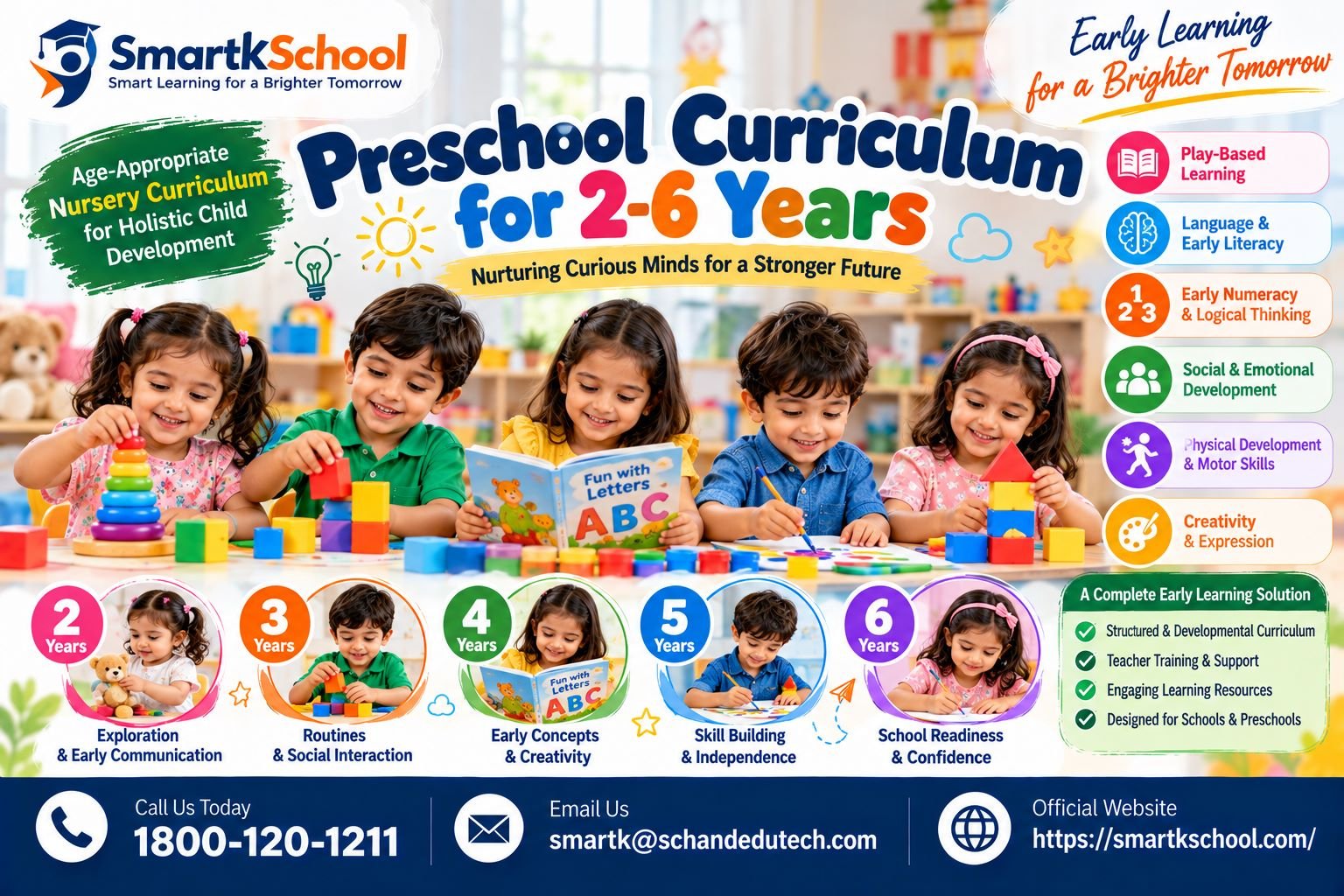
The early childhood years represent an important period when children develop communication abilities, independence, curiosity, and an understanding of the world around them. For preschools, the challenge is creating educational experiences that recognise children’s changing needs while encouraging enjoyable and meaningful learning.
A thoughtfully designed preschool curriculum for 2-6 years introduces learning experiences progressively, supporting children as they move from sensory exploration towards greater confidence, cooperation, and school readiness.
At the same time, an effective nursery curriculum establishes the foundation for language development, early mathematical understanding, creative expression, and social interaction.
For preschool owners, educators, and parents, understanding how learning experiences should develop across different age groups is essential for supporting balanced childhood development.
Why Early Childhood Learning Should Follow Developmental Stages
Children do not develop every skill at the same pace. Their interests, attention, communication abilities, and physical coordination change as they grow.
An activity suitable for an older preschool child may be unnecessarily demanding for a younger learner.
Similarly, activities designed for toddlers may not provide sufficient challenge for children preparing to enter primary school.
A progressive curriculum recognises these differences and introduces appropriate learning opportunities.
The objective is not to accelerate development but to provide suitable opportunities for exploration and participation.
What Is a Preschool Curriculum for 2-6 Years?
A preschool curriculum for 2-6 years is an educational framework designed to support children’s development through age-appropriate activities, learning objectives, and classroom experiences.
It generally covers foundational learning during the preschool years, although programme names and age-group divisions may differ between institutions.
The curriculum should address language, cognitive, physical, social, emotional, and creative development.
Rather than focusing exclusively on academic outcomes, it should support the whole child through play, movement, communication, and practical exploration.
Age-Wise Learning: Building Skills Progressively
A successful curriculum creates continuity between different developmental stages without treating age ranges as rigid performance standards.
Ages 2–3: Learning Through Sensory Exploration
Younger children benefit from activities involving touch, movement, sound, and observation.
Suitable experiences include:
- Exploring safe sensory materials.
- Listening to short stories and rhymes.
- Playing with large building blocks.
- Identifying familiar objects and pictures.
- Participating in movement-based games.
These activities encourage curiosity, early communication, and physical coordination.
Ages 3–4: Developing Communication and Social Skills
At this stage, many children begin participating more actively in group experiences.
A suitable nursery curriculum can introduce picture conversations, sorting games, creative artwork, storytelling, and imaginative play.
Teachers can encourage children to express preferences, recognise familiar patterns, and practise cooperation.
Ages 4–5: Strengthening Foundational Concepts
Children may become interested in more detailed activities involving numbers, sounds, shapes, and patterns.
Teachers can introduce playful sound-awareness activities, counting objects, simple sequencing, and collaborative projects.
The emphasis should remain on understanding concepts rather than memorising answers.
Ages 5–6: Supporting Primary School Readiness
Older preschool learners can benefit from opportunities to develop independence, early literacy awareness, reasoning, and communication.
Activities may include storytelling, recognising relationships between sounds and symbols, exploring quantities, and solving simple practical problems.
These stages are broad planning guides. Individual children may require different levels of support or challenge.
Nursery Curriculum: Creating the Bridge Between Exploration and Structured Learning
A nursery curriculum plays an important role in helping children become familiar with classroom routines and group learning experiences.
For many children, nursery provides an introduction to organised educational activities outside their home environment.
The curriculum should build confidence through predictable routines, positive relationships, and engaging activities.
For example, a classroom theme about animals can incorporate storytelling, animal sounds, movement, picture recognition, and creative expression.
This approach allows children to explore one familiar concept through several developmental areas.
Why Sensory and Motor Development Deserve Attention
Early learning is closely connected with physical exploration.
Fine motor activities such as threading large beads, manipulating clay, and using child-safe drawing tools help children develop hand coordination.
Gross motor activities involving balancing, jumping, dancing, and outdoor movement support physical confidence.
A preschool curriculum for 2-6 years should include opportunities for both types of movement.
Teachers must ensure materials are age-appropriate, closely supervise activities, and avoid small objects that could present choking hazards.
Physical development should be recognised as an essential part of learning rather than a separate recreational activity.
Developing Language Through Everyday Conversations
Communication skills develop through meaningful interaction with adults and other children.
Storytelling, songs, picture discussions, and role-playing can encourage listening and expressive language.
Teachers can introduce new vocabulary while allowing children to communicate through words, gestures, and creative expression.
In multilingual classrooms, children’s home languages can provide valuable connections to unfamiliar concepts.
The goal is to develop communication confidence and language awareness without expecting identical progress from every learner.
Teaching Early Mathematical Thinking Through Play
Young children encounter mathematical ideas during ordinary classroom activities.
Matching objects introduces similarities and differences. Arranging blocks develops spatial awareness. Comparing containers creates opportunities to discuss size and quantity.
Teachers can also use counting songs, shape hunts, and sorting activities.
A strong curriculum helps children understand mathematical relationships before introducing excessive written exercises.
These experiences prepare learners for more formal mathematical concepts through exploration and practical understanding.
Creating an Inclusive Preschool Learning Environment
Children enter preschool with different abilities, backgrounds, interests, and experiences.
A curriculum should allow multiple ways to participate in the same activity.
For example, during storytelling, some children may answer questions verbally, while others may point towards pictures or use gestures.
Teachers can adapt materials, provide visual support, and offer additional assistance where necessary.
Inclusive educational planning helps children participate meaningfully without unnecessary comparison or pressure.
How Teachers Can Observe Developmental Progress
Preschool assessment should focus on understanding children’s learning rather than ranking performance.
Educators can observe communication, social interaction, problem-solving, movement, and creative participation.
Classroom portfolios may contain drawings, activity samples, photographs, and brief observational notes.
These records can help teachers identify emerging interests and adapt future learning opportunities.
Parents can also benefit from clear explanations of their child’s developmental experiences.
Choosing Appropriate Learning Materials
The materials used in a nursery curriculum should encourage active participation and exploration.
Useful resources may include picture books, puppets, building blocks, art materials, sensory resources, and age-appropriate puzzles.
Schools should prioritise safety, durability, educational purpose, and flexibility.
Materials that can be used in several different activities often provide richer learning opportunities than resources intended for only one fixed exercise.
Frequently Asked Questions (FAQs)
1. What should a preschool curriculum for 2-6 years include?
It should include age-appropriate activities supporting communication, cognitive development, physical coordination, social-emotional skills, creativity, and early learning concepts.
2. What is the main purpose of a nursery curriculum?
A nursery curriculum introduces children to enjoyable learning experiences, classroom routines, social interaction, and foundational developmental skills.
3. Should children learn reading and writing during preschool?
Children can develop early literacy awareness through stories, rhymes, conversations, drawing, and sound-related activities. Formal expectations should reflect individual developmental readiness.
4. How are activities different for younger and older preschool children?
Younger children generally benefit from sensory and movement-based exploration, while older children may engage with more complex language, reasoning, and collaborative activities.
5. How can parents support preschool learning at home?
Parents can encourage conversations, shared reading, imaginative play, creative activities, and opportunities for independence without introducing unnecessary academic pressure.
Media Contact
Department: Early Childhood Curriculum and Nursery Education Enquiries
Email: smartk@schandedutech.com
Phone: 1800-120-1211
Official Website: https://smartkschool.com/