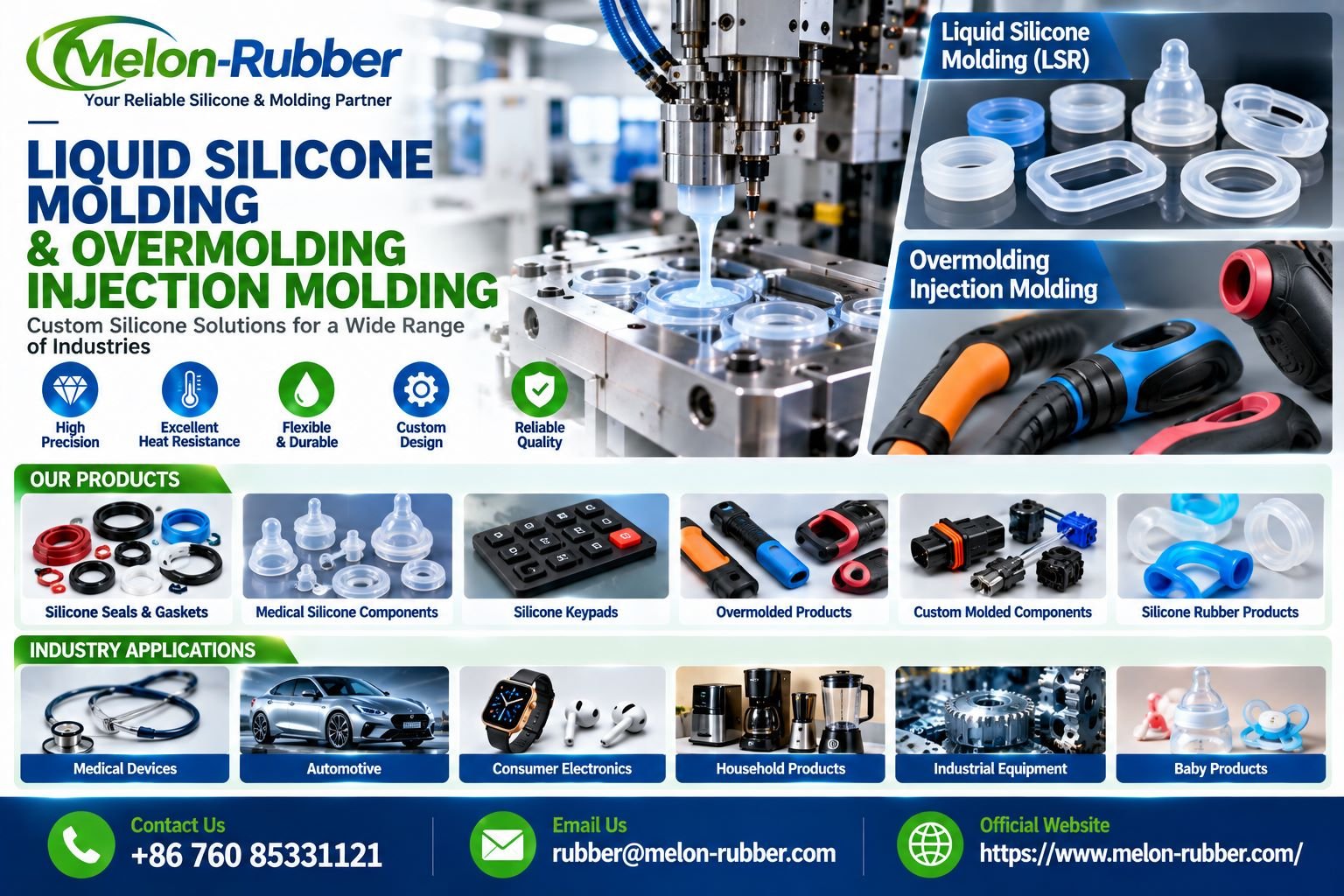
Product manufacturers are exploring more efficient ways to combine flexibility, durability, and functionality within compact product designs. From wearable electronics and healthcare devices to automotive controls and household appliances, demand for integrated soft-touch components is influencing manufacturing decisions.
Liquid Silicone Molding provides a specialised manufacturing approach for producing flexible silicone components with controlled dimensions and complex geometries.
Meanwhile, Overmolding Injection Molding enables manufacturers to combine compatible materials within a single component, potentially reducing the need for separate mechanical assembly operations.
These technologies offer product designers opportunities to integrate sealing features, protective surfaces, and ergonomic elements directly into manufactured parts.
However, successful implementation depends on material compatibility, component design, manufacturing precision, and appropriate product testing.
Why Multi-Material Product Design Is Gaining Attention
Modern product development frequently requires components that perform several functions simultaneously.
An electronic housing may need a rigid structure, a comfortable grip, and protection around selected interfaces.
Traditionally, these requirements might involve manufacturing separate parts and assembling them afterwards.
Multi-material manufacturing can offer alternative construction methods.
By integrating compatible rigid and flexible materials, engineers may simplify certain product designs and reduce individual assembly operations.
The manufacturing approach should be selected according to actual performance requirements rather than appearance alone.
What Is Liquid Silicone Molding?
Liquid Silicone Molding is a manufacturing process that uses liquid silicone rubber, commonly known as LSR, to produce flexible molded components.
LSR systems typically consist of two components that are mixed and processed using specialised equipment.
The material is injected into a heated mold, where it cures into the required shape.
Depending on the selected grade and process, LSR can offer flexibility, elastic recovery, and resistance to certain environmental conditions.
Common applications include seals, flexible buttons, protective components, and specialised industrial parts.
However, material characteristics vary between silicone formulations.
Manufacturers should confirm the required mechanical, chemical, and temperature properties before selecting an LSR grade.
Understanding Overmolding Injection Molding
Overmolding Injection Molding is a manufacturing technique in which one material is molded onto or around another material or previously manufactured component.
The process can be used to combine materials with different functional properties.
For example, a rigid plastic substrate may be combined with a flexible material to create a comfortable gripping surface.
Depending on the design and equipment, overmolding may involve insert molding, multiple molding stages, or specialised multi-material systems.
The materials must be compatible with the selected processing method.
Some combinations rely on chemical adhesion, while others require mechanical retention features.
How These Technologies Work Together
Liquid silicone molding and overmolding can be combined in suitable applications.
A manufacturer may produce a rigid substrate and subsequently mold compatible silicone material around selected surfaces.
This arrangement can create integrated seals, flexible interfaces, or protective features.
However, silicone does not automatically bond effectively to every plastic or metal.
Successful integration may require specialised material grades, surface preparation, primers, or mechanical interlocking designs.
Engineering validation is essential before approving a design for production.
Manufacturing Applications Across Industries
These technologies can support different product development requirements.
| Industry | Potential Application | Functional Objective |
| Consumer Electronics | Flexible buttons and protective interfaces | Comfort and component protection |
| Healthcare Equipment | Silicone seals and device interfaces | Flexible, cleanable components |
| Automotive | Control surfaces and sealing elements | Grip and environmental protection |
| Household Appliances | Handle coverings and flexible parts | Ergonomics and usability |
| Industrial Equipment | Protective interfaces and custom seals | Functional integration |
For regulated applications, manufacturers must also confirm applicable material and product requirements.
Designing Better Soft-Touch Components
A soft-touch surface should provide more than an attractive texture.
Its dimensions, flexibility, surface finish, and position can influence usability.
Designers should consider how users hold, press, or handle the completed product.
For example, a handheld electronic device may benefit from carefully positioned flexible gripping areas.
However, excessively soft materials may create problems where structural support is required.
Engineers should define suitable hardness and mechanical characteristics according to product function.
Prototype evaluation can help identify improvements before final tooling approval.
Why Material Compatibility Is Critical
Material selection is among the most important considerations in multi-material manufacturing.
Different materials respond differently to heat, pressure, chemical exposure, and mechanical stress.
A rigid substrate must tolerate the relevant molding conditions without unacceptable deformation.
The silicone formulation must also satisfy the intended product requirements.
Poor compatibility can contribute to separation, distortion, or inconsistent component performance.
Material selection should therefore include practical manufacturing trials and appropriate testing.
Assumptions about adhesion should never replace verified performance data.
Reducing Assembly Complexity Through Integrated Design
Combining suitable materials within one component may reduce the number of separate parts required in an assembly.
For example, an integrated flexible seal may eliminate a separate installation operation in certain designs.
However, overmolding also introduces tooling and processing requirements.
The overall economic benefit depends on production volume, mold complexity, material costs, and inspection requirements.
Engineers should compare alternative manufacturing approaches before selecting a final design.
A simplified assembly is valuable only when the resulting component meets performance and cost expectations.
Why Mold Design Influences Product Quality
Precision tooling is essential for manufacturing complex silicone and multi-material components.
Mold design affects material flow, part dimensions, surface appearance, and removal from the tooling.
Engineers must consider gate positions, venting, parting lines, and potential flash formation.
For overmolded components, accurate substrate positioning is particularly important.
Incorrect positioning may produce inconsistent material distribution or dimensional defects.
Well-planned tooling supports repeatable manufacturing when combined with controlled production conditions.
Quality Testing for Multi-Material Components
Finished components should be evaluated according to their intended functions.
Relevant assessments may include dimensional inspection, hardness testing, adhesion evaluation, and functional performance checks.
Sealing applications may require additional leak or compression-related testing.
Repeated movement or handling may also justify durability assessments.
However, no single test establishes suitability for every application.
Manufacturers should develop acceptance criteria based on engineering requirements and foreseeable operating conditions.
Documented testing helps support consistent production quality.
Selecting a Suitable Manufacturing Partner
Businesses considering silicone and overmolding solutions should evaluate:
- Technical Experience: Familiarity with LSR and multi-material processes.
- Material Knowledge: Understanding of silicone grades and substrate compatibility.
- Tooling Capabilities: Ability to manufacture suitable precision molds.
- Prototype Support: Opportunities to evaluate designs before production.
- Inspection Procedures: Appropriate dimensional and performance verification.
- Engineering Communication: Clear handling of specifications and design revisions.
A suitable supplier should explain both manufacturing possibilities and technical limitations.
Frequently Asked Questions (FAQs)
1. What is Liquid Silicone Molding?
It is a manufacturing process that injects liquid silicone rubber into a mold, where the material cures into a flexible component with the required geometry.
2. What is Overmolding Injection Molding?
It is a process that molds one material onto or around another component to combine suitable materials within a manufactured part.
3. Can liquid silicone rubber be overmolded onto plastic?
Yes, certain material combinations are suitable, but successful bonding depends on substrate compatibility, silicone formulation, and manufacturing conditions.
4. Which industries use silicone overmolding?
Potential applications include electronics, automotive products, healthcare equipment, household appliances, and industrial components.
5. How can manufacturers improve overmolded component quality?
Manufacturers should prioritise compatible materials, precision tooling, appropriate process controls, prototype validation, and defined quality testing.
Media Contact
Department: Silicone Molding and Custom Manufacturing Enquiries
Email : rubber@melon-rubber.com
Contact : 86-0760-85331121
Official Website : https://www.melon-rubber.com/