
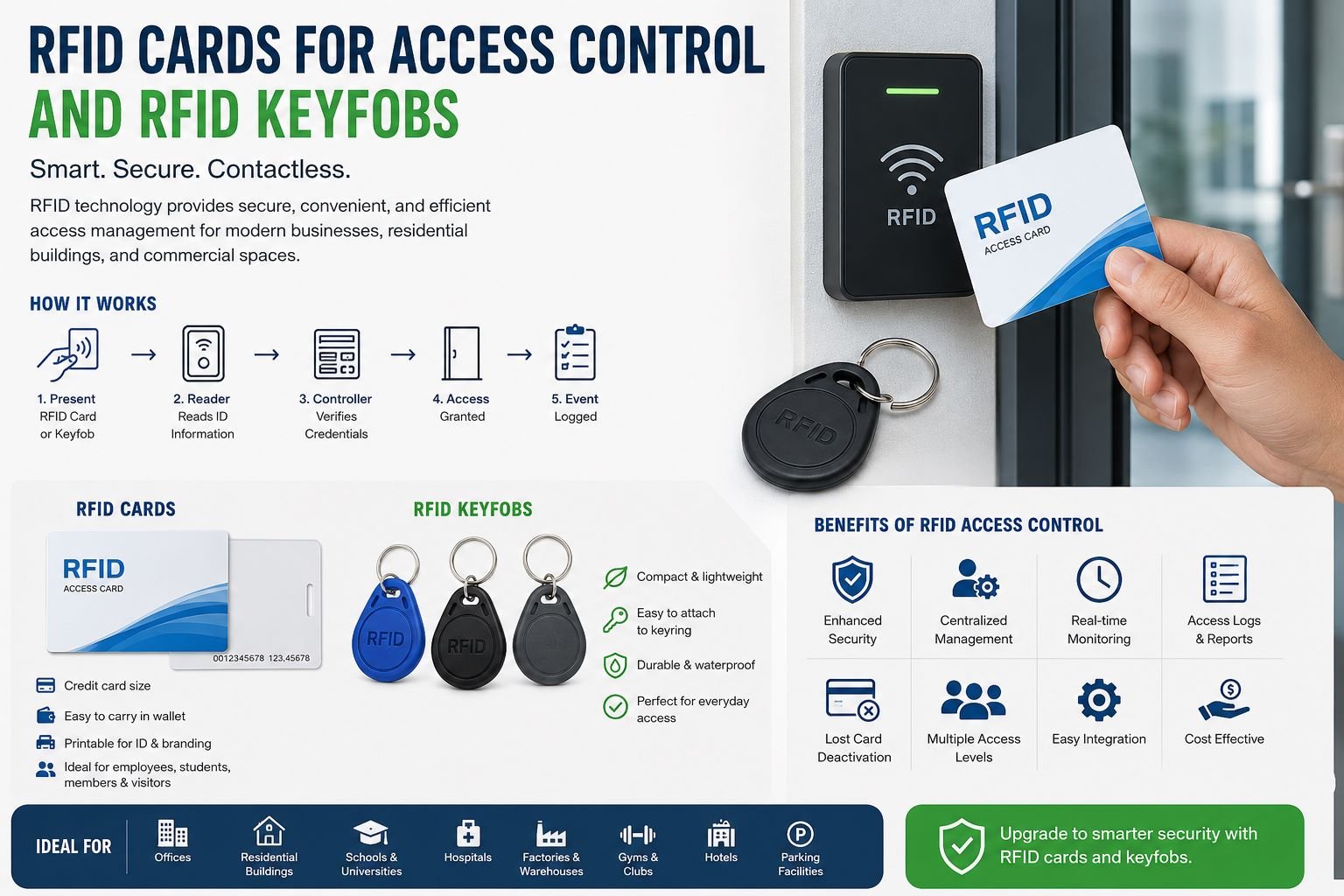
Every secure doorway represents a basic question: who should be allowed through it? Traditional keys answer that question simply—anyone holding the correct key can enter. Modern organizations need considerably more control. They may need to determine who entered, which areas a person can access, when access is permitted, and how quickly authorization can be withdrawn.
This is where RFID cards for access control and RFID keyfobs become valuable. These credentials transform physical entry into a digitally managed process. Instead of relying solely on possession of a mechanical key, RFID systems connect a person’s credential with predefined permissions inside an access control platform.
Understanding RFID access therefore requires looking beyond the card or keyfob itself and examining the complete security ecosystem behind it.
The Technology Hidden Inside an RFID Credential
An RFID credential may look remarkably simple, but internally it typically contains two fundamental components: a microchip and an antenna.
The chip stores or processes credential-related information, while the antenna enables communication with a compatible reader.
Many access-control credentials are passive. They do not continuously transmit information and generally do not require an internal battery. When brought into the electromagnetic field generated by an appropriate reader, the credential receives enough energy to participate in communication.
The reader then obtains or exchanges the information required by that credential technology.
This interaction is the foundation behind both RFID cards for access control and RFID keyfobs.
What Actually Happens When Someone Taps an RFID Card?
A successful access transaction involves more than simply scanning a number.
The complete workflow may include:
- The reader detects the credential.
- Communication begins using the supported RFID technology.
- Credential information is read or authenticated.
- The access controller receives relevant data.
- The system identifies the associated user.
- Door and schedule permissions are evaluated.
- Access is approved or rejected.
- The locking mechanism responds.
- The event may be recorded in the access database.
All these steps can occur quickly enough that the user experiences them as a simple tap-and-enter process.
RFID Cards as Digital Identity Credentials
The purpose of RFID cards for access control extends beyond unlocking doors.
A properly configured card can represent an individual’s identity within a physical security system. Administrators associate that credential with a person and then define what that person is permitted to do.
Consider a corporate office with several security zones. An employee might have permission for the lobby, office floor, cafeteria, and meeting areas but not the data center.
A facilities manager could have broader authorization, while a temporary visitor might receive limited access that automatically expires.
This makes access control permission-based rather than purely key-based.
Why the Card Format Still Has Important Advantages
RFID cards provide a relatively large printable surface. Consequently, organizations can combine electronic authentication with visible identification.
A card may display:
- Employee photograph
- Full name
- Department
- Job designation
- Employee number
- Organization logo
- Validity information
This makes cards particularly practical in corporate offices, hospitals, educational campuses, manufacturing facilities, laboratories, and other environments where people need to display identification.
RFID Keyfobs Solve a Different Usability Problem
RFID keyfobs provide similar access functionality in a smaller physical form.
Rather than being stored in a wallet or worn on a lanyard, a keyfob can remain attached to a keyring. This can make daily access more convenient for users who do not require a visible identification badge.
Residential complexes provide a useful example. Residents may not need their photograph or name printed on an access credential. They simply need a convenient credential for building entrances, parking areas, elevators, or shared facilities.
In this situation, RFID keyfobs can offer a more practical form factor.
Understanding the Difference Between Identification and Authentication
This distinction is important when evaluating RFID security.
Identification answers:
“Which credential is this?”
Authentication provides stronger assurance that the credential is legitimate according to the security mechanisms supported by the system.
Older or simpler RFID technologies may rely more heavily on identifiers. More sophisticated credential technologies can incorporate authentication and cryptographic security features.
Therefore, organizations should not evaluate RFID security solely by asking whether a product is “RFID.”
The specific credential technology matters significantly.
RFID Frequencies and Why They Matter
Different RFID technologies operate at different frequencies.
125 kHz Low-Frequency Systems
125 kHz credentials have historically been common in proximity-based physical access control.
They typically operate over relatively short distances and remain present in many existing installations.
However, organizations upgrading security should evaluate the specific credential technology rather than assuming all 125 kHz systems provide identical capabilities.
13.56 MHz High-Frequency Systems
13.56 MHz is widely used by various contactless smart-card technologies.
Depending on the credential platform, these technologies can support more sophisticated communication, data handling, and security capabilities.
The Compatibility Problem Buyers Often Overlook
Frequency alone does not determine interoperability.
A reader and credential could both operate at 13.56 MHz and still be incompatible because they use different protocols, chip technologies, applications, or authentication methods.
Before purchasing RFID cards for access control, verify the exact credential specification supported by the installed reader.
RFID Cards vs RFID Keyfobs: Which Format Fits Better?
| Requirement | RFID Card | RFID Keyfob |
| Door authentication | Excellent | Excellent |
| Visual identification | Excellent | Limited |
| Photo printing | Suitable | Generally unsuitable |
| Carrying convenience | Wallet/lanyard | Keyring |
| Branding opportunities | Extensive | Limited |
| Residential use | Good | Excellent |
| Corporate ID use | Excellent | Good |
| Parking access | Good | Excellent |
| Credential permissions | Configurable | Configurable |
| System compatibility | Technology-dependent | Technology-dependent |
The key lesson is that physical format and electronic technology are separate considerations.
Access Control Becomes More Powerful Through Permission Rules
One of RFID’s greatest advantages is that administrators can potentially change access privileges without replacing door hardware.
Permissions may be based on:
- Person
- Role
- Department
- Location
- Door
- Security zone
- Day of week
- Time period
- Credential validity
- Employment status
Imagine that a cleaning contractor needs building access between 7:00 PM and 10:00 PM Monday through Friday.
Instead of issuing a conventional master key, the organization can potentially provide a credential configured specifically for those authorized areas and times.
What Happens When an RFID Card Is Lost?
Loss management demonstrates one of the clearest differences between electronic credentials and conventional keys.
If a mechanical master key disappears, determining whether someone copied it can be difficult. Depending on the risk, organizations may need to replace cylinders or locks.
When RFID cards for access control are properly managed, administrators can usually revoke the missing credential’s authorization in the access control system.
A replacement credential can then be enrolled for the user.
The same principle applies to lost RFID keyfobs.
Importantly, rapid reporting remains necessary. A lost credential may remain usable until it is deactivated.
Access Logs Add Another Layer of Visibility
RFID access systems can potentially create records of access activity.
Depending on configuration, records may show:
- Credential or user
- Door or reader
- Date
- Time
- Access granted
- Access denied
These records can support security reviews, incident investigation, operational analysis, and compliance processes.
Organizations should simultaneously establish appropriate policies concerning access-log retention, employee privacy, and authorized use of collected data.
Security Should Be Designed According to Risk
Not every doorway requires the same security architecture.
A low-risk shared meeting area has different requirements from a server room containing sensitive infrastructure.
Organizations can therefore adopt layered security.
Standard Security Areas
A compatible RFID credential may provide sufficient access control for general areas.
Higher-Risk Areas
Sensitive locations may require stronger credential technologies or additional verification.
Multi-Factor Physical Access
Depending on system capabilities, organizations can combine RFID with:
- RFID card + PIN
- RFID card + fingerprint
- RFID credential + biometric verification
- Credential + additional security approval
This reduces dependence on possession of a single credential.
Frequently Asked Questions
What are RFID cards for access control?
They are contactless credentials used by compatible access systems to identify users and determine their entry permissions.
What are RFID keyfobs used for?
They provide compact RFID-based access credentials commonly used for doors, residential entrances, parking facilities, offices, and memberships.
Does an RFID card require a battery?
Many common access-control RFID cards are passive and operate without an internal battery.
Can one RFID card access different buildings?
Potentially yes, when compatible systems and administrative permissions are configured to recognize the credential.
Are all 13.56 MHz RFID cards identical?
No. Different chip technologies, standards, protocols, security mechanisms, and data structures can operate at the same frequency.
Can an RFID keyfob be disabled?
Yes. In centrally managed systems, administrators can normally revoke authorization associated with a lost or inactive credential.
Are RFID cards suitable for outdoor access?
They can be, but card durability, reader protection, temperature, moisture, and environmental ratings should be evaluated.
Can RFID credentials have expiration dates?
Access platforms can often configure temporary or scheduled credential validity, depending on system capabilities.
Can RFID systems record denied entry attempts?
Many access control platforms can record both successful and unsuccessful access events.
Which credential is better for employees?
RFID cards are often preferred when photo identification is required; keyfobs are convenient when compact access credentials are the priority.
https://newsgrow.blogspot.com/2026/08/from-pocket-sized-tools-to-digital.html
https://freeseobacklinks.online/why-nfc-tags-and-smart-wristbands-are-changing-the-future-of-events/
https://blogstream.net/event-technology-enters-a-new-phase-as-nfc-wristbands-gain-wider-attention/
https://newsgrow.blogspot.com/2026/08/nfc-tag-china-market-advances-as-nfc.html