Two important solutions designed for these different purposes are the dumbwaiter lift and passenger lift. Although both operate vertically, their construction, capacity, safety systems, applications, and operating requirements are very different.
Choosing the correct lift is essential for convenience, safety, space utilisation, and long-term building efficiency. A restaurant may require a compact dumbwaiter for transferring meals between floors, while a hotel, hospital, office, or residential property usually needs a passenger lift for comfortable human transportation.
Understanding how both systems work helps architects, property owners, contractors, and businesses make better decisions.
What Is a Dumbwaiter Lift?
A dumbwaiter lift is a compact lifting system designed specifically for transporting goods rather than people. It normally travels between two or more floors through a dedicated shaft and includes a small enclosed cabin or platform.
Dumbwaiters are commonly found in:
- Restaurants and commercial kitchens
- Hotels and resorts
- Hospitals
- Libraries
- Offices
- Retail stores
- Warehouses
- Villas and large residential properties
A restaurant, for example, can use a dumbwaiter lift to transfer prepared dishes from a basement kitchen to an upper-floor dining area. Used plates can then be sent back to the washing section without employees repeatedly using staircases.
This improves workflow while reducing manual carrying.
How a Dumbwaiter Lift Improves Daily Operations
The primary advantage of a dumbwaiter is operational convenience.
Employees frequently carrying food trays, documents, laundry, cartons, medicines, or supplies between floors can experience fatigue and lose valuable working time. A dedicated goods lift simplifies this movement.
Important benefits include:
- Faster transportation between floors
- Reduced manual material handling
- Better staff productivity
- Improved organisation
- Efficient use of limited building space
- Lower risk of items being dropped during transportation
Because the cabin is relatively small, a dumbwaiter lift can often be installed where a conventional goods elevator would require considerably more space.
However, people must never travel inside a dumbwaiter unless the system has specifically been designed, certified, and approved for passenger transportation.
What Is a Passenger Lift?
A passenger lift is an elevator engineered to transport people safely between different floors of a building. It includes a larger cabin, passenger controls, doors, safety mechanisms, communication features, and systems designed to provide comfortable vertical movement.
Passenger elevators are widely installed in:
- Residential apartments
- Corporate offices
- Shopping centres
- Hotels
- Hospitals
- Educational buildings
- Commercial complexes
- Public buildings
Capacity varies according to the building and expected traffic. Smaller residential systems may carry only a few passengers, while commercial elevators can accommodate considerably larger loads.
A carefully selected passenger lift improves accessibility and makes multi-storey buildings easier to use.
Benefits of Installing a Passenger Lift
Accessibility is one of the biggest reasons to install a passenger elevator.
Stairs can become difficult for elderly people, children, individuals with disabilities, or anyone carrying luggage and personal belongings.
A passenger lift provides easier movement while helping buildings create a more inclusive environment.
Other important advantages include:
- Comfortable floor-to-floor transportation
- Better accessibility
- Faster movement in tall buildings
- Improved property functionality
- Professional building appearance
- Convenient transportation of light personal items
- Greater usability for elderly and mobility-impaired users
In busy commercial buildings, passenger elevators also help manage traffic efficiently during working hours.
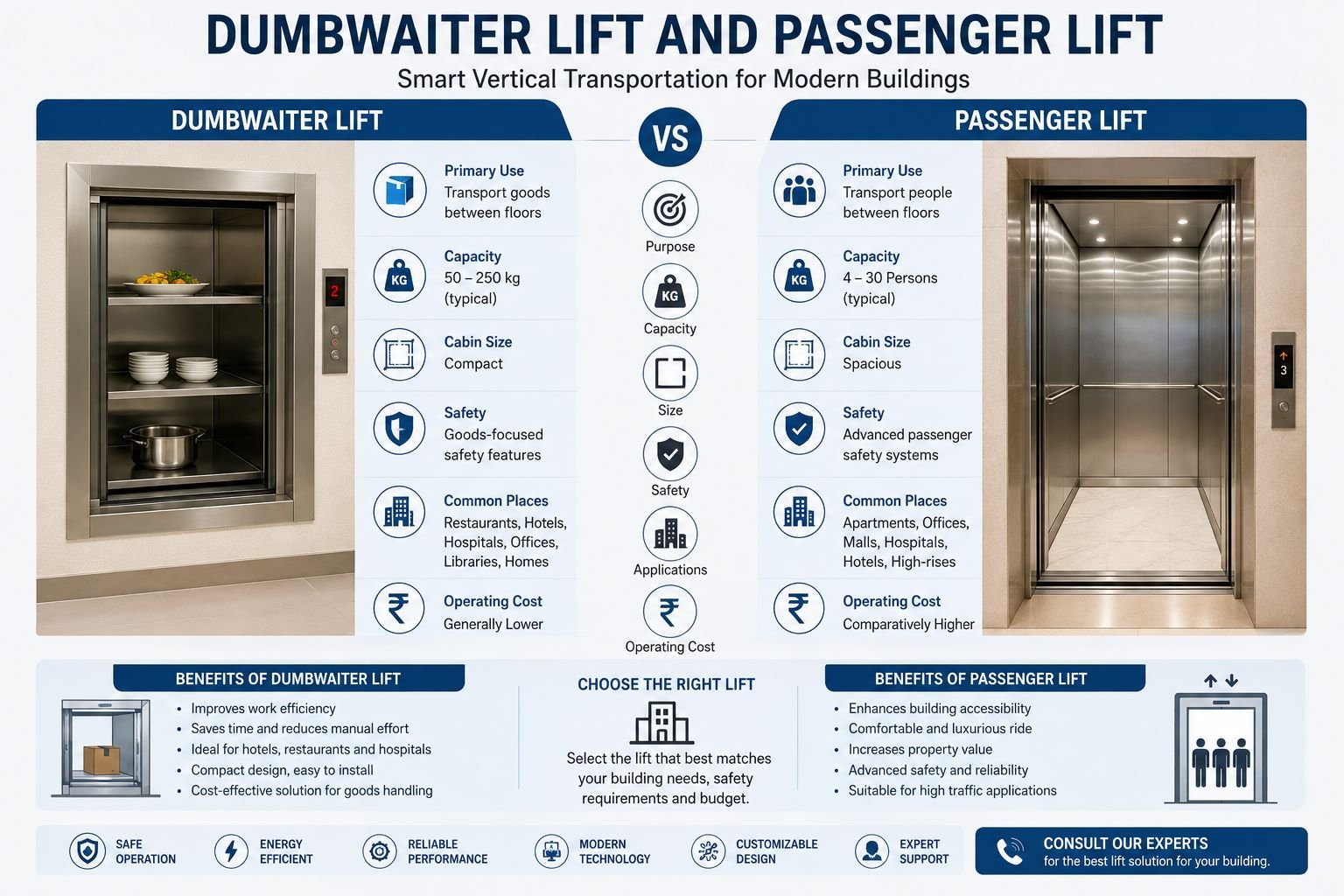
Dumbwaiter Lift vs Passenger Lift
| Feature | Dumbwaiter Lift | Passenger Lift |
| Main Purpose | Transporting goods | Transporting people |
| Cabin Size | Small | Medium to large |
| Typical Capacity | Light to moderate goods | Multiple passengers |
| Human Transportation | Not normally permitted | Specifically designed for people |
| Space Requirement | Relatively low | Higher |
| Common Locations | Kitchens, hotels, offices | Homes, offices, hospitals |
| Installation Complexity | Usually simpler | More comprehensive |
| Safety Requirements | Goods-focused protection | Extensive passenger safety systems |
| Typical Cost | Generally lower | Generally higher |
| Controls | Simple call buttons | Full passenger control panel |
The correct selection therefore depends primarily on what needs to be transported.
Important Features of a Modern Dumbwaiter Lift
Modern dumbwaiters can include various features depending on the application.
Useful features may include:
- Automatic landing doors
- Stainless-steel cabin interiors
- Floor-level call buttons
- Interlocking doors
- Emergency stopping mechanisms
- Overload protection
- Multiple stopping levels
- Smooth starting and stopping
- Easy-to-clean surfaces
Food-service environments commonly prefer stainless steel because it is durable and relatively easy to maintain.
When selecting a dumbwaiter lift, buyers should consider cabin dimensions, lifting capacity, travel height, number of floors, door configuration, and expected operating frequency.
Important Features of a Modern Passenger Lift
Passenger elevators usually require more advanced control and safety technology.
Typical features include:
- Automatic doors
- Emergency alarm systems
- Overload detection
- Emergency lighting
- Floor indicators
- Automatic rescue systems
- Intercom or communication facilities
- Smooth acceleration and braking
- Accessibility controls
- Energy-efficient drive technology
Some contemporary lifts also support destination control, touchless buttons, intelligent monitoring, and customised cabin finishes.
The exact specifications should always reflect applicable building codes, accessibility requirements, traffic demand, and local elevator regulations.
Choosing the Correct Lift Capacity
Capacity should never be selected randomly.
For a dumbwaiter lift, calculate the maximum weight likely to be transported during normal operations. A small restaurant carrying meal trays requires a very different capacity from a warehouse transferring cartons or stock.
For a passenger lift, consider:
- Number of building floors
- Expected daily visitors
- Peak-hour traffic
- Building purpose
- Accessibility requirements
- Available shaft dimensions
Selecting insufficient capacity can create congestion and excessive equipment usage, while unnecessarily high capacity can increase installation and operating costs.
Professional lift planning can help determine an appropriate balance.
Installation and Space Planning
Proper planning should begin before lift installation.
For both systems, engineers normally evaluate shaft dimensions, travel distance, structural conditions, landing positions, electrical requirements, and equipment placement.
A dumbwaiter generally requires less space because its cabin and shaft are smaller.
Passenger elevators require more detailed planning because people must enter and exit comfortably and safely. Adequate landing space, door clearance, cabin dimensions, ventilation, accessibility, and emergency provisions must therefore be considered.
For new buildings, incorporating the lift during the architectural planning stage can make installation considerably easier.
Lift Safety Should Always Be a Priority
Safety should never be compromised when installing either type of lift.
A professionally installed elevator should incorporate suitable safety mechanisms and comply with applicable local regulations and technical standards.
Regular maintenance is equally important.
Maintenance typically includes checking:
- Doors and interlocks
- Control systems
- Drive components
- Electrical connections
- Safety devices
- Cabin movement
- Emergency mechanisms
Preventive servicing helps identify developing problems before they cause major breakdowns.
Users should also follow the manufacturer’s recommended load limits and operating instructions.
Energy Efficiency and Maintenance Considerations
Modern lift technology has become more energy efficient compared with many older systems.
Efficient motors, intelligent controllers, LED lighting, standby modes, and advanced drive technology can reduce unnecessary electricity consumption.
Maintenance costs depend on several factors, including:
- Lift type
- Usage frequency
- Number of floors
- Equipment design
- Component quality
- Service agreement
- Availability of replacement parts
Selecting equipment based only on the lowest purchase price may not provide the best long-term value.
Durability, maintenance support, energy consumption, installation quality, and spare-part availability should also influence purchasing decisions.
Frequently Asked Questions
1. What is a dumbwaiter lift used for?
A dumbwaiter is mainly used for transporting food, documents, laundry, medicines, packages, and other small goods between floors.
2. Can people travel inside a dumbwaiter?
Normally, no. Standard dumbwaiters are designed for goods rather than human transportation.
3. What is the main purpose of a passenger lift?
A passenger lift safely transports people between different floors of residential, commercial, institutional, and public buildings.
4. Which lift needs more installation space?
A passenger lift normally requires more space because it has a larger cabin, doors, shaft, and passenger-related safety provisions.
5. Can a dumbwaiter be installed in a restaurant?
Yes. Restaurants are among the most common locations because dumbwaiters can efficiently move meals, utensils, and kitchen supplies between floors.
6. Are passenger lifts suitable for residential buildings?
Yes. Passenger elevators are widely installed in apartments, villas, and multi-storey homes to improve accessibility and convenience.
7. How should lift capacity be selected?
Capacity should be selected according to expected loads, building usage, number of floors, available space, and peak transportation requirements.
8. Do lifts require regular maintenance?
Yes. Scheduled inspection and preventive maintenance help maintain safe operation, reliability, and equipment performance.
9. What is the difference between a dumbwaiter and goods lift?
A dumbwaiter is generally smaller and designed for relatively light goods, while larger goods lifts may transport heavier commercial or industrial loads.
10. Which lift is more expensive?
Passenger lifts are generally more expensive because they require larger cabins, sophisticated controls, extensive safety systems, and more complex installation.