
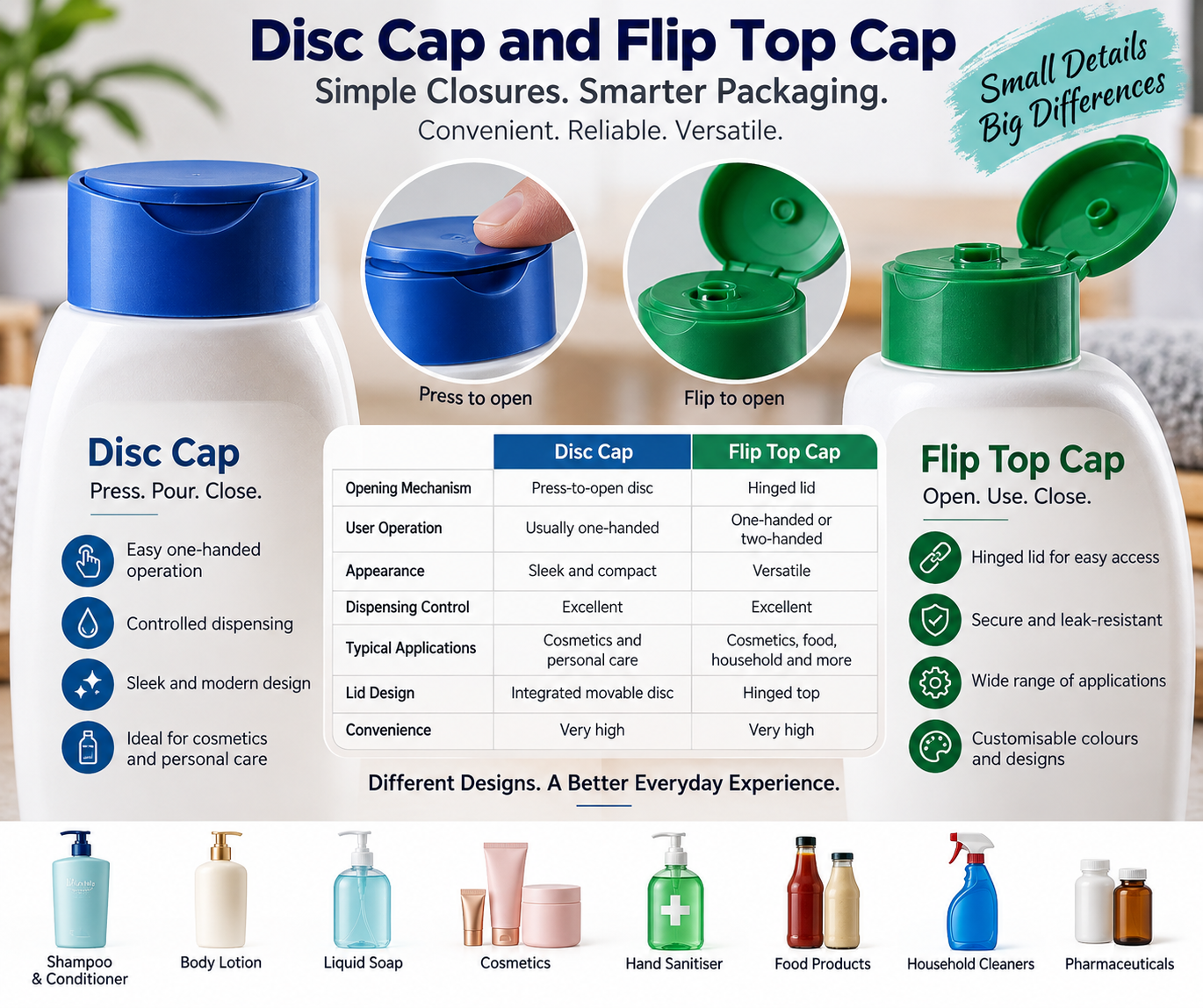
Among the most widely used dispensing closures in personal care, cosmetics, household products, pharmaceuticals, and other industries are the disc cap and flip top cap.
Although both closure types provide convenient product dispensing, their mechanisms, appearance, application suitability, and customer experience are different. Choosing between a disc cap and flip top cap therefore requires an understanding of product viscosity, bottle design, dispensing requirements, transportation conditions, and target consumers.
What Is a Disc Cap?
A disc cap, commonly called a disc-top closure, is a dispensing cap designed with a press-operated disc mechanism. When one side of the upper disc is pressed, the opposite side rises and exposes the dispensing opening.
The consumer can dispense the required amount without completely removing the closure. Pressing the raised section again closes the opening.
Disc caps are commonly seen on:
- Shampoo bottles
- Conditioners
- Body lotions
- Hair oils
- Hand creams
- Liquid soaps
- Skin-care products
- Hotel toiletries
Their streamlined design makes them particularly attractive for cosmetic and personal-care packaging.
How Does a Disc Cap Work?
A disc cap normally contains a closure body and movable upper disc. The internal mechanism allows controlled opening and closing with simple finger pressure.
The operating process is straightforward:
- Press one side of the disc.
- The dispensing side automatically rises.
- Tilt or squeeze the bottle to release the product.
- Press the raised portion back into position.
This simple operation enables convenient one-handed dispensing, making disc-top closures suitable for products frequently used in bathrooms, salons, hotels, spas, and households.
What Is a Flip Top Cap?
A flip top cap is another popular dispensing closure featuring a hinged lid. Users lift or flip open the upper lid to expose the dispensing orifice and press it downward after use.
The closure usually remains permanently attached to the bottle, reducing the possibility of losing the cap.
Flip-top closures are widely used with:
- Shampoo
- Face wash
- Shower gel
- Hand sanitiser
- Lotion
- Sauces and food products
- Pharmaceutical products
- Household cleaners
Different dispensing-hole dimensions can be developed according to product consistency and required flow.
How Does a Flip Top Cap Work?
The operating mechanism of a flip top cap is based on an integrated hinge connecting the closure body and lid.
Users simply lift the lid, dispense the product and snap the lid closed. Many designs produce a noticeable clicking action that gives consumers confidence that the closure has been properly secured.
A well-designed flip-top closure can provide:
- Easy opening
- Convenient closing
- Controlled dispensing
- Improved product protection
- Reduced leakage
- Comfortable everyday operation
These benefits explain why flip tops have become common across multiple packaging industries.
Disc Cap vs Flip Top Cap: Key Differences
Both closures provide excellent convenience, but understanding their differences helps manufacturers select a suitable solution.
| Feature | Disc Cap | Flip Top Cap |
| Opening mechanism | Press-operated disc | Hinged lid |
| User operation | Press and dispense | Flip open and dispense |
| Appearance | Sleek and premium | Practical and versatile |
| One-handed usage | Excellent | Very good |
| Popular applications | Cosmetics and personal care | Personal care, food and household |
| Dispensing control | Highly controlled | Depends on opening size |
| Closure style | Disc top | Hinged top |
| Customisation | Colour, finish, size | Colour, finish, shape, orifice |
The correct choice depends on the product rather than simply the appearance of the closure.
Benefits of Using Disc Caps
The growing popularity of the disc cap comes from its combination of attractive appearance and practical functionality.
Convenient Dispensing
Consumers do not need to unscrew or completely remove the closure. A simple press gives immediate access to the product.
Premium Appearance
Disc closures create a clean, contemporary bottle profile, which makes them particularly suitable for beauty, salon and personal-care brands.
Controlled Product Flow
A carefully selected dispensing hole can help consumers control product quantity and reduce unnecessary waste.
One-Handed Operation
The press-to-open design works well for products used frequently during showers, grooming routines or professional salon treatments.
Benefits of Using Flip Top Caps
A flip top cap offers excellent flexibility across various packaging applications.
Easy Consumer Experience
Consumers quickly understand the opening mechanism, making the closure suitable for products targeted at a broad audience.
Attached Lid
Because the lid remains connected through the hinge, consumers do not need to handle a separate cap.
Wide Application Range
Different flip-top designs can accommodate liquids, gels, creams and semi-viscous formulations.
Secure Closing
Properly manufactured closures provide reliable snapping action that can help minimise accidental opening during normal handling.
Important Factors When Selecting a Packaging Cap
Selecting a closure requires more than matching the cap diameter with the bottle neck.
Manufacturers should evaluate:
- Product viscosity
- Bottle neck dimensions
- Dispensing-hole diameter
- Closure material
- Leakage resistance
- Opening force
- Hinge durability
- Product compatibility
- Transportation requirements
- Consumer usage habits
Testing the bottle, formulation and closure together is particularly important before large-scale production.
Material Selection for Disc and Flip Top Closures
Polypropylene, commonly known as PP, is frequently used for dispensing closures because it offers good flexibility, durability, chemical resistance and moulding performance.
However, material suitability should always be evaluated according to the formulation.
Certain oils, chemicals, solvents or active ingredients may require compatibility testing. Closure selection should therefore form part of the complete packaging-development process instead of being treated as an independent purchasing decision.
Customisation Opportunities
Packaging closures also provide important branding opportunities.
Manufacturers may customise a disc cap or flip top cap through:
- Custom colours
- Glossy surfaces
- Matte finishes
- Different closure diameters
- Custom dispensing openings
- Embossed branding
- Debossed logos
- Special closure shapes
- Colour matching with bottles
Consistent bottle and closure styling can significantly improve shelf presentation and strengthen brand recognition.
Which Closure Should You Choose?
Choose a disc cap when you want sophisticated appearance, easy press operation and controlled dispensing, particularly for cosmetic or premium personal-care products.
Choose a flip top cap when flexibility, familiar operation, secure closing and suitability across multiple product categories are priorities.
Before finalising either option, request samples and conduct practical testing with the actual bottle and formulation.
Frequently Asked Questions
1. What is a disc cap used for?
A disc cap is primarily used for controlled dispensing of shampoos, lotions, conditioners, creams and other personal-care formulations.
2. What is a flip top cap?
A flip top cap is a dispensing closure with an attached hinged lid that opens and closes without being removed from the bottle.
3. Which is better: disc cap or flip top cap?
Neither is universally better. The ideal closure depends on product viscosity, bottle design, dispensing requirements and customer expectations.
4. Can disc caps be used for shampoo?
Yes. Disc-top closures are commonly used with shampoos, conditioners and other hair-care products.
5. Are flip top caps suitable for cosmetics?
Yes. They are widely used for face wash, moisturisers, body lotions, cleansing products and other cosmetic formulations.
6. Can closure colours be customised?
Yes. Manufacturers can generally produce closures in custom colours depending on order quantity, material and production requirements.
7. What material is normally used for these caps?
Polypropylene is commonly used because of its durability, flexibility and suitability for hinge and dispensing mechanisms.
8. How can cap leakage be prevented?
Correct neck compatibility, suitable liners or sealing structures, proper closure dimensions and packaging tests help reduce leakage risk.
9. Can dispensing-hole sizes be customised?
Yes. Orifice size can often be adjusted according to viscosity and desired dispensing volume.
10. Should closures be tested before bulk production?
Absolutely. Compatibility, leakage, dispensing, transportation, opening and closing tests should be performed with the actual bottle and formulation.