
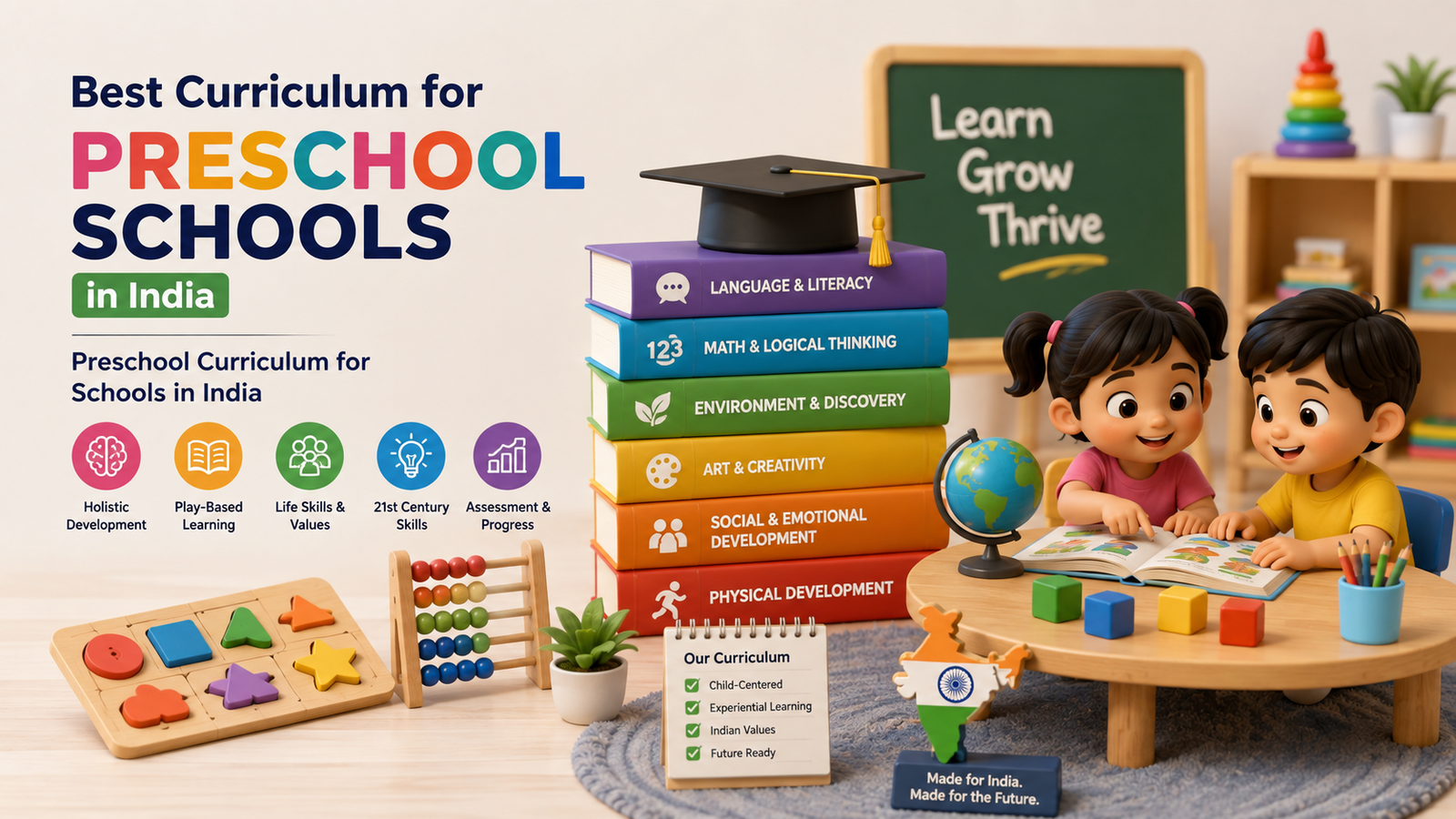
The preschool years play an important role in shaping how children communicate, explore, solve problems, build relationships, and develop confidence. Choosing the best curriculum for preschool schools is therefore about much more than selecting books, worksheets, or classroom activities. A strong curriculum creates an environment where children learn naturally through play, interaction, movement, creativity, stories, and practical experiences.
For Indian educators, selecting the right preschool curriculum for schools in India also requires understanding local culture, language diversity, developmental needs, and the expectations children may encounter when they enter formal schooling. The most effective approach balances school readiness with age-appropriate learning rather than introducing academic pressure too early.
What Makes a Preschool Curriculum Truly Effective?
A high-quality preschool curriculum considers the development of the whole child. Instead of measuring progress only through alphabet recognition, counting, or writing ability, it supports cognitive, physical, linguistic, emotional, social, and creative development.
Children at this age learn effectively when they can touch, observe, question, imitate, experiment, move, and communicate.
The best curriculum for preschool schools should therefore include:
- Play-based and activity-oriented learning
- Language and communication development
- Early mathematical thinking
- Fine and gross motor activities
- Creative arts, music, dance, and movement
- Social and emotional development
- Environmental awareness
- Storytelling and imaginative activities
- Practical life experiences
- Opportunities for independent exploration
These areas work together rather than functioning as isolated subjects.
Why Play-Based Learning Should Be at the Centre
Play is not simply recreation for preschool children. It is one of their primary ways of understanding the world.
Consider a pretend grocery shop in a classroom. Children may count fruits, identify colours, communicate with classmates, understand buying and selling, practise decision-making, and develop vocabulary during a single activity.
Similarly, building a tower with blocks develops spatial awareness, coordination, patience, creativity, and problem-solving abilities.
An effective preschool curriculum for schools in India should therefore provide structured learning opportunities without controlling every moment of a child’s experience. Teachers can introduce concepts while allowing children enough freedom to discover solutions independently.
Balancing Academics With Holistic Development
Parents naturally want children to be prepared for primary school. However, school readiness should not mean turning preschool into an early version of formal schooling.
Literacy can begin with stories, rhymes, conversations, picture recognition, phonological awareness, and letter exploration. Numeracy can develop through sorting objects, counting toys, identifying patterns, comparing quantities, and recognising shapes.
A balanced approach looks like this:
| Learning Area | Traditional Approach | Child-Centred Approach |
| Language | Repeated writing | Stories, sounds and conversation |
| Mathematics | Memorising numbers | Counting and manipulating objects |
| Science | Learning facts | Observation and experiments |
| Creativity | Copying examples | Open-ended art activities |
| Assessment | Tests | Observation and portfolios |
| Social Skills | Limited focus | Group activities and collaboration |
The best curriculum for preschool schools connects academic foundations with experiences children can understand and enjoy.
Essential Learning Areas for Indian Preschools
A well-designed preschool curriculum for schools in India should organise learning around interconnected developmental areas.
Language development can include storytelling, vocabulary games, listening activities, rhymes, picture conversations, phonics readiness, and opportunities for children to express themselves.
Early numeracy can introduce counting, classification, sequencing, shapes, sizes, patterns, measurement concepts, and comparisons such as more, less, longer, shorter, heavy, and light.
Physical development deserves equal attention. Running, balancing, jumping, outdoor games, drawing, threading, clay modelling, puzzles, and building activities strengthen gross and fine motor abilities.
Social-emotional learning helps children understand feelings, cooperate with classmates, wait for turns, communicate needs, manage small conflicts, and gradually become more independent.
Creative development through painting, music, role-play, craft, dance, and imaginative storytelling gives children opportunities to communicate ideas beyond conventional academic activities.
Creating a Preschool Curriculum for Schools in India
India’s linguistic, cultural, and social diversity makes localisation particularly important. A curriculum developed for one environment cannot always be applied identically everywhere.
Schools can incorporate familiar festivals, local stories, traditional games, regional environments, community occupations, food, animals, plants, and everyday experiences into classroom learning.
Language deserves particular attention. Children may speak one language at home while encountering another language at school. Teachers should create supportive transitions instead of treating a child’s home language as an obstacle.
A suitable preschool curriculum for schools in India should consequently remain flexible enough for schools and educators to adapt classroom experiences to their communities.
Role of Teachers in Successful Curriculum Delivery
Even an excellent curriculum cannot succeed without capable teachers.
Preschool teachers are facilitators, observers, storytellers, activity planners, and emotional guides. They need to recognise that children develop at different speeds.
Effective teachers observe how children participate, communicate, solve problems, and interact with others. They then adjust activities according to individual needs.
Teacher development should cover classroom management, child development, activity-based teaching, observation techniques, inclusive education, parent communication, storytelling, safety, and positive behaviour guidance.
The best curriculum for preschool schools therefore provides educators with practical teaching resources rather than simply prescribing what must be completed each week.
Assessment Without Creating Pressure
Assessment in preschool should help teachers understand development rather than rank children.
Observation is particularly useful. Teachers can document children’s participation, communication, emerging skills, interests, creativity, and areas requiring additional support.
Useful assessment methods include:
- Classroom observations
- Activity records
- Children’s work portfolios
- Developmental checklists
- Teacher notes
- Parent discussions
This approach gives families meaningful information about progress without creating unnecessary examination pressure.
How Technology Should Be Used in Preschool
Technology can support early learning, but it should not replace physical exploration, conversation, outdoor activities, books, toys, art, or interaction with teachers.
Interactive storytelling, carefully selected educational content, audio resources, and teacher-led digital activities can occasionally enhance lessons.
However, young children need real-world experiences. Building an actual block tower provides sensory, physical, spatial, and problem-solving experiences that simply moving digital blocks on a screen cannot fully reproduce.
The best curriculum for preschool schools uses technology purposefully and in moderation.
How Schools Can Choose the Right Curriculum
Before adopting a curriculum, school leaders should examine whether it matches children’s developmental stages and the school’s educational philosophy.
Ask whether the programme encourages curiosity rather than memorisation. Check whether teachers receive structured lesson guidance while retaining flexibility. Examine whether activities cover physical, cognitive, linguistic, social, emotional, and creative development.
Schools should also evaluate classroom resources, teacher training requirements, assessment systems, parent engagement, inclusivity, cultural relevance, and progression between age groups.
The strongest preschool curriculum for schools in India should be practical enough to work inside real classrooms, not merely impressive on paper.
Frequently Asked Questions About Preschool Curriculum
1. What is the best curriculum for preschool schools?
The best curriculum combines play-based learning, early literacy and numeracy, physical development, creativity, communication, and social-emotional learning.
2. What should a preschool curriculum include?
It should include language, numeracy, movement, art, music, storytelling, environmental exploration, practical activities, and social-emotional experiences.
3. Is play-based learning effective for preschoolers?
Yes. Purposeful play allows children to develop communication, problem-solving, motor, social, and thinking skills through meaningful experiences.
4. Should preschool children receive homework?
Learning at this age should primarily be experiential. Simple parent-child activities such as storytelling or observing nature can be more appropriate than extensive worksheets.
5. How should preschool children be assessed?
Observation, portfolios, developmental records, activity participation, and parent-teacher discussions are useful approaches.
6. Is phonics important in preschool education?
Age-appropriate phonological and phonics activities can support early reading development when introduced through engaging activities rather than excessive drilling.
7. How important is teacher training?
It is essential because teachers need to understand child development and know how to convert curriculum objectives into meaningful classroom experiences.
8. Should every child learn at the same speed?
No. Development varies considerably between children, so preschool programmes should provide flexibility and appropriate support.
9. What role should parents have in preschool learning?
Parents can reinforce learning through conversations, reading, everyday counting, creative activities, routines, and regular communication with teachers.
10. What makes a preschool curriculum suitable for Indian schools?
Cultural relevance, multilingual sensitivity, age-appropriate activities, local context, holistic development, flexibility, and preparation for future schooling are important considerations.