
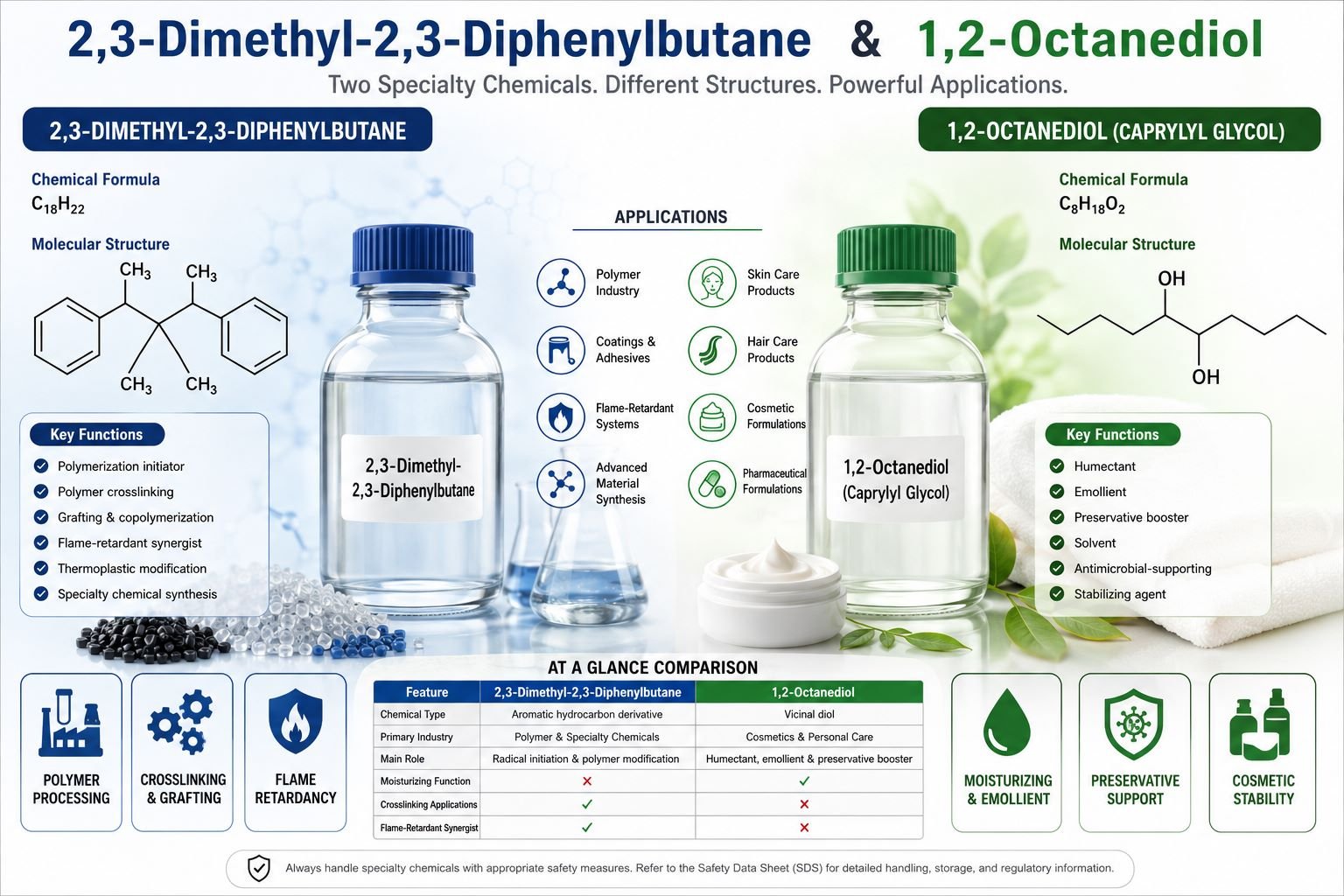
Specialty chemicals create value by performing highly specific functions in manufacturing and formulation. 2,3-dimethyl-2,3-diphenylbutane and 1,2-octanediol are two examples with very different roles. One is associated with high-temperature radical chemistry and polymer modification, while the other is a multifunctional diol widely used in personal-care formulation.
Their molecular structures help explain how they behave, where they perform best, and why factors such as purity, processing temperature, concentration, storage, and chemical compatibility are important.
Chemical Structure and Fundamental Characteristics
2,3-dimethyl-2,3-diphenylbutane, also called bicumene, has the molecular formula C18H22 and a molecular weight of approximately 238.37 g/mol. Its CAS number is 1889-67-4. Commercial reference data describes it as a solid specialty chemical.
Its structure contains two phenyl-containing tertiary carbon centers connected through a carbon-carbon bond. This structural arrangement becomes particularly important at elevated temperatures because thermal decomposition can generate reactive carbon-centered species.
1,2-octanediol has the molecular formula C8H18O2 and a molecular weight of approximately 146.23 g/mol. Its CAS number is 1117-86-8. In cosmetic applications, it is commonly identified as caprylyl glycol.
The molecule consists of an eight-carbon chain containing hydroxyl groups on the first and second carbon atoms. This combination provides both hydrophilic and lipophilic characteristics.
How 2,3-Dimethyl-2,3-Diphenylbutane Works in Radical Chemistry
The most technically significant property of 2,3-dimethyl-2,3-diphenylbutane is its ability to generate carbon-centered radicals under sufficiently high-temperature conditions.
Research involving polyethylene modification shows that thermolysis of bicumene can produce cumyl radicals. These radicals can abstract hydrogen atoms from hydrocarbon chains and generate polymer macroradicals capable of entering subsequent chemical reactions.
Role in Polymer Grafting
One studied application involves radical-mediated grafting of vinyltriethoxysilane onto polyethylene.
The process generally involves:
- Thermal generation of cumyl radicals.
- Hydrogen abstraction from the polyethylene backbone.
- Formation of reactive polymer radicals.
- Reaction between those radicals and functional monomers.
- Formation of chemically modified polymer chains.
Such chemistry can introduce functionality into polymers without completely changing the original polymer manufacturing route.
Polymer Processing Benefits
Radical modification can influence several properties, including molecular architecture, melt behavior, grafting efficiency, branching, and crosslinking tendency.
The final effect depends heavily on processing conditions.
Important parameters include:
- initiator concentration;
- processing temperature;
- residence time;
- oxygen concentration;
- polymer molecular weight;
- monomer concentration;
- mixing efficiency.
Why Temperature Control Is Essential
Research has studied bicumene thermolysis at temperatures between approximately 220°C and 310°C during polyethylene grafting.
Insufficient temperature can restrict radical formation, while excessively aggressive processing can promote chain scission, oxidation, or other unwanted reactions. Industrial optimization therefore requires controlled experimentation rather than simply increasing initiator concentration.
Deep Understanding of 1,2-Octanediol
The chemistry of 1,2-octanediol differs significantly. Instead of primarily acting as a radical source, it functions as a versatile formulation ingredient.
PubChem lists cosmetic functions for caprylyl glycol including emollient, humectant, and hair-conditioning roles.
Moisture Retention and Conditioning
The hydroxyl groups within 1,2-octanediol contribute to intermolecular interactions and moisture-related functionality, while its hydrocarbon chain provides lipophilic character.
This balance can make the ingredient useful in products such as:
- moisturizing creams;
- facial lotions;
- shampoos;
- conditioners;
- cleansing products;
- body-care formulations;
- emulsions.
Its multifunctional nature is particularly attractive to formulators seeking ingredients capable of contributing more than one performance benefit.
Preservation-Support Properties of 1,2-Octanediol
Another important characteristic of 1,2-octanediol is its role in modern preservation strategies.
Scientific literature discussing cosmetic preservation identifies medium-chain 1,2-diols, including caprylyl glycol, as compounds with antimicrobial characteristics related partly to their amphiphilic nature.
How Preservation Support Works
The molecule contains a hydrophobic carbon chain alongside hydrophilic hydroxyl groups. This structural balance can influence interactions with microbial membranes.
As a result, 1,2-octanediol may complement conventional preservation systems and help formulators design more efficient ingredient combinations.
However, it should not automatically be considered a universal standalone preservative. Actual performance depends on:
- formulation pH;
- water activity;
- packaging;
- manufacturing hygiene;
- other preservatives present;
- emulsifier system;
- target microorganisms.
Commercial products should therefore undergo appropriate microbiological challenge and stability testing.
Technical Comparison of Both Chemicals
| Characteristic | 2,3-Dimethyl-2,3-Diphenylbutane | 1,2-Octanediol |
| Molecular formula | C18H22 | C8H18O2 |
| Molecular weight | ~238.37 g/mol | ~146.23 g/mol |
| Chemical category | Aromatic hydrocarbon | Vicinal diol |
| Major function | Radical generation | Multifunctional formulation ingredient |
| Major industry | Polymer processing | Personal care and cosmetics |
| Key behavior | Thermal radical formation | Humectancy and preservation support |
| Important control | Processing temperature | Formula compatibility |
Purity and Quality Requirements
The technical performance of specialty chemicals can vary when purity and impurity profiles change.
For 2,3-dimethyl-2,3-diphenylbutane, manufacturers should examine assay, physical form, storage recommendations, thermal characteristics, and compatibility with the intended polymer process.
For 1,2-octanediol, formulators should consider purity, color, odor, water content, grade, microbiological quality, and regulatory suitability.
Reliable sourcing should include a Certificate of Analysis, Safety Data Sheet, specification sheet, batch traceability, and appropriate storage information.
Frequently Asked Questions
What is 2,3-dimethyl-2,3-diphenylbutane?
It is a specialty organic compound used in radical chemistry and studied for high-temperature polymer modification processes.
What is another name for this compound?
It is commonly referred to as bicumene.
What is its molecular formula?
The formula of 2,3-dimethyl-2,3-diphenylbutane is C18H22.
Why is it useful in polymer processing?
It can thermally generate cumyl radicals that participate in hydrogen abstraction, grafting, chain modification, and related radical reactions.
What is 1,2-octanediol?
1,2-octanediol is an eight-carbon diol used as a multifunctional ingredient in cosmetic and specialty formulations.
Is 1,2-octanediol caprylyl glycol?
Yes. Caprylyl glycol is a widely used cosmetic name for 1,2-octanediol.
What is its chemical formula?
Its molecular formula is C8H18O2.
Why is 1,2-octanediol used in skin-care products?
It can contribute humectant, emollient, conditioning, sensory, and preservation-support functions.
Can 1,2-octanediol replace preservatives?
Not automatically. Preservation effectiveness depends on the entire formulation and should be verified through microbiological testing.
Are these two chemicals interchangeable?
No. They differ considerably in molecular structure, mechanism, processing requirements, and industrial application.