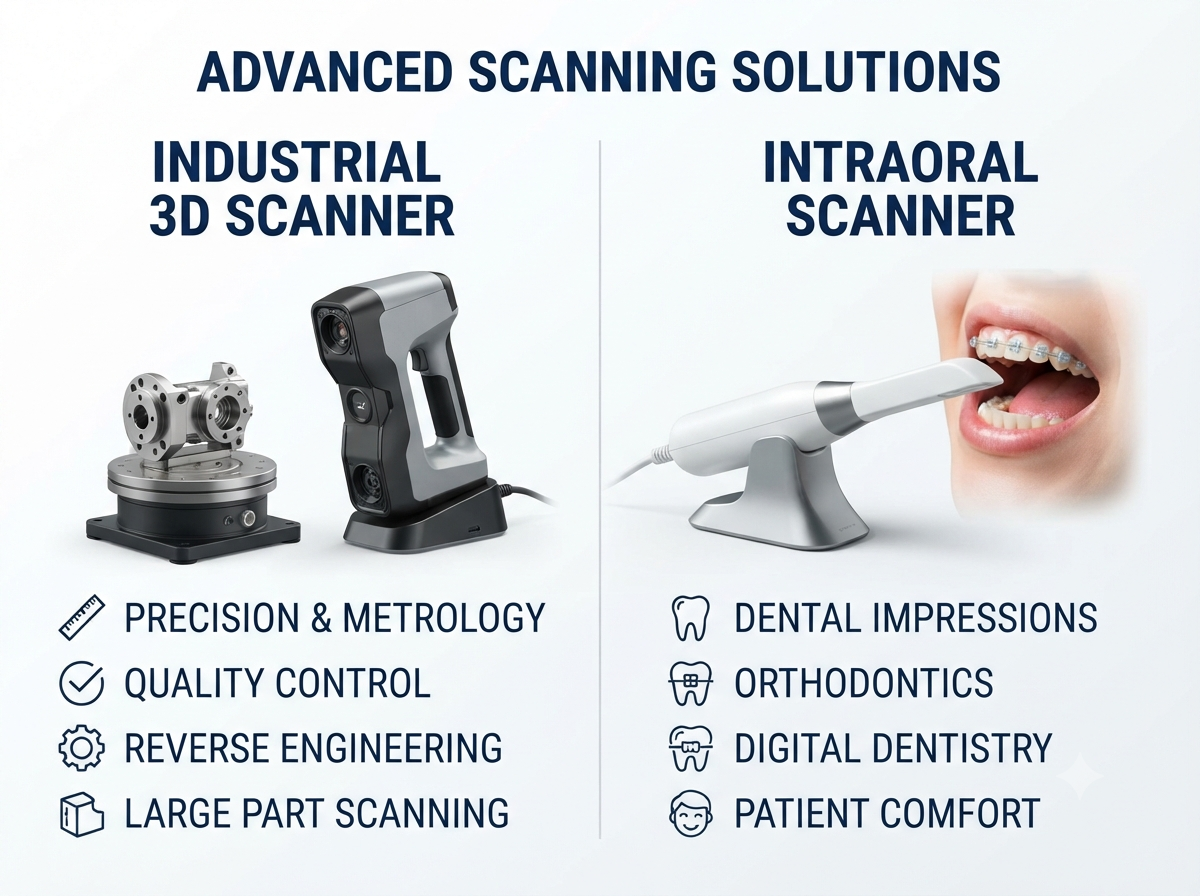
Three-dimensional scanning has changed how professionals capture shape, size, and surface detail. From factories measuring components to dentists creating digital impressions, advanced scanners are replacing many manual processes. Two important technologies are the industrial 3D scanner and the intraoral scanner. Although they serve different industries, both use optical capture and software to improve accuracy, speed, and digital workflows.
What Is an Industrial 3D Scanner?
An industrial 3D scanner captures a physical object’s geometry and converts it into a digital model. It may use structured light, laser triangulation, photogrammetry, or optical methods.
Manufacturers use these scanners for inspection, reverse engineering, product development, dimensional analysis, tooling verification, and maintenance. Many systems capture complex free-form surfaces quickly without touching the component.
Key Industrial Applications
Typical applications include:
- Checking manufactured parts against CAD models
- Inspecting molds, dies, castings, and machined components
- Reverse engineering discontinued or undocumented parts
- Measuring wear, deformation, and assembly alignment
- Creating digital twins for engineering and maintenance
- Supporting rapid prototyping and additive manufacturing
Why Accuracy Matters
Measurement errors can cause scrap, rework, and delays. A reliable scanning workflow helps teams identify deviations earlier, improve process control, and document quality through inspection reports.
What Is an Intraoral Scanner?
An intraoral scanner is a handheld dental device that captures teeth, gums, bite relationships, and nearby oral structures. Software combines images into a three-dimensional digital impression.
Digital scanning can reduce reliance on conventional impression materials. Dentists, orthodontists, and laboratories use the files to plan treatment and manufacture restorations through CAD/CAM workflows.
Common Dental Uses
An intraoral scanning system is commonly used for:
- Crowns and bridges
- Clear aligners
- Implant restorations
- Veneers and inlays
- Night guards and retainers
- Digital smile design
- Patient monitoring
Patient and Clinical Benefits
Digital impressions can be more comfortable. Clinicians can review scans immediately, rescan missing areas, and share files efficiently with laboratories or specialists.
Industrial 3D Scanner vs Intraoral Scanner
Both technologies create 3D data, but their environments and workflows differ.
| Feature | Industrial 3D Scanner | Intraoral Scanner |
| Primary field | Manufacturing and engineering | Dentistry |
| Typical subject | Parts, tools, assemblies | Teeth and oral tissues |
| Main purpose | Inspection and reverse engineering | Digital dental impressions |
| Environment | Factory, lab, workshop, field | Dental clinic |
| Output | Point cloud, mesh, inspection data | Dental 3D model |
| Key priority | Dimensional accuracy | Accuracy and clinical usability |
The best system depends on the application. Accuracy, resolution, software compatibility, calibration, workflow speed, and operator training influence results.
How 3D Scanning Technology Works
Many scanners use light patterns to calculate surface coordinates. Software aligns scans and creates a point cloud or polygon mesh.
For industrial scanning, the model can be compared with CAD geometry to generate deviation maps and dimensional reports. In dentistry, captured images are stitched together in real time to create a digital dental arch for compatible design or laboratory systems.
Clean surfaces, correct distance, steady movement, calibration, and proper settings can affect data quality.
Benefits of Digital 3D Scanning
The growth of the industrial 3D scanner and intraoral scanner reflects a wider shift toward digital workflows. Benefits include:
- Faster data collection
- Reduced manual measurement
- Better digital traceability
- Clear visualization of complex geometry
- More efficient collaboration
- Improved repeatability
- Integration with CAD, CAM, and analysis software
Digital models support remote review, reporting, manufacturing, treatment planning, and historical comparison.
How to Choose the Right Scanner
Before purchasing, define application requirements instead of focusing only on headline specifications.
For industrial use, evaluate component size, required tolerance, surface finish, portability, scanning volume, software tools, and CAD compatibility.
For dental use, consider accuracy, ergonomics, speed, sterilization workflow, laboratory connectivity, software costs, support, and restorative or orthodontic compatibility.
A demonstration using real parts or clinical cases is often more useful than specifications alone.
Future of 3D Scanning
3D scanning is becoming smarter as software improves. Artificial intelligence can assist with alignment, recognition, inspection, margin identification, and workflow guidance. Cloud tools also simplify model sharing across engineering teams, laboratories, clinics, and production facilities.
Portable hardware, improved optics, and automation may reduce operator effort. Calibration, validation, and workflow control will remain important.
Frequently Asked Questions
1. What is an industrial 3D scanner used for?
It captures 3D geometry for inspection, reverse engineering, quality control, design, maintenance, and manufacturing.
2. Is 3D scanning better than manual measurement?
It can be faster for complex surfaces, although traditional tools may still be suitable for simple dimensions.
3. What file formats do industrial scanners produce?
Common outputs include point clouds, meshes, reports, and formats such as STL, OBJ, PLY, or proprietary measurement files.
4. What is an intraoral scanner used for?
It creates digital impressions for crowns, bridges, implants, aligners, retainers, orthodontics, and other dental workflows.
5. Is intraoral scanning comfortable?
Many patients find it more comfortable because it can reduce the need for conventional impression materials.
6. Are intraoral scanners accurate?
Modern systems can provide clinically useful accuracy when used correctly, but results depend on the device, case, strategy, and workflow.
7. Do 3D scanners require calibration?
Many professional systems require periodic calibration or verification to maintain reliable measurement performance.
8. Can scanned data be used with CAD software?
Yes. Compatible files can be imported into CAD, inspection, reverse-engineering, dental design, or manufacturing software.
9. What affects 3D scan quality?
Surface reflectivity, movement, distance, calibration, lighting, geometry, operator technique, and processing can affect results.
10. How should a business choose a scanner?
Start with accuracy needs, workflow compatibility, operating costs, software capabilities, support, and testing.