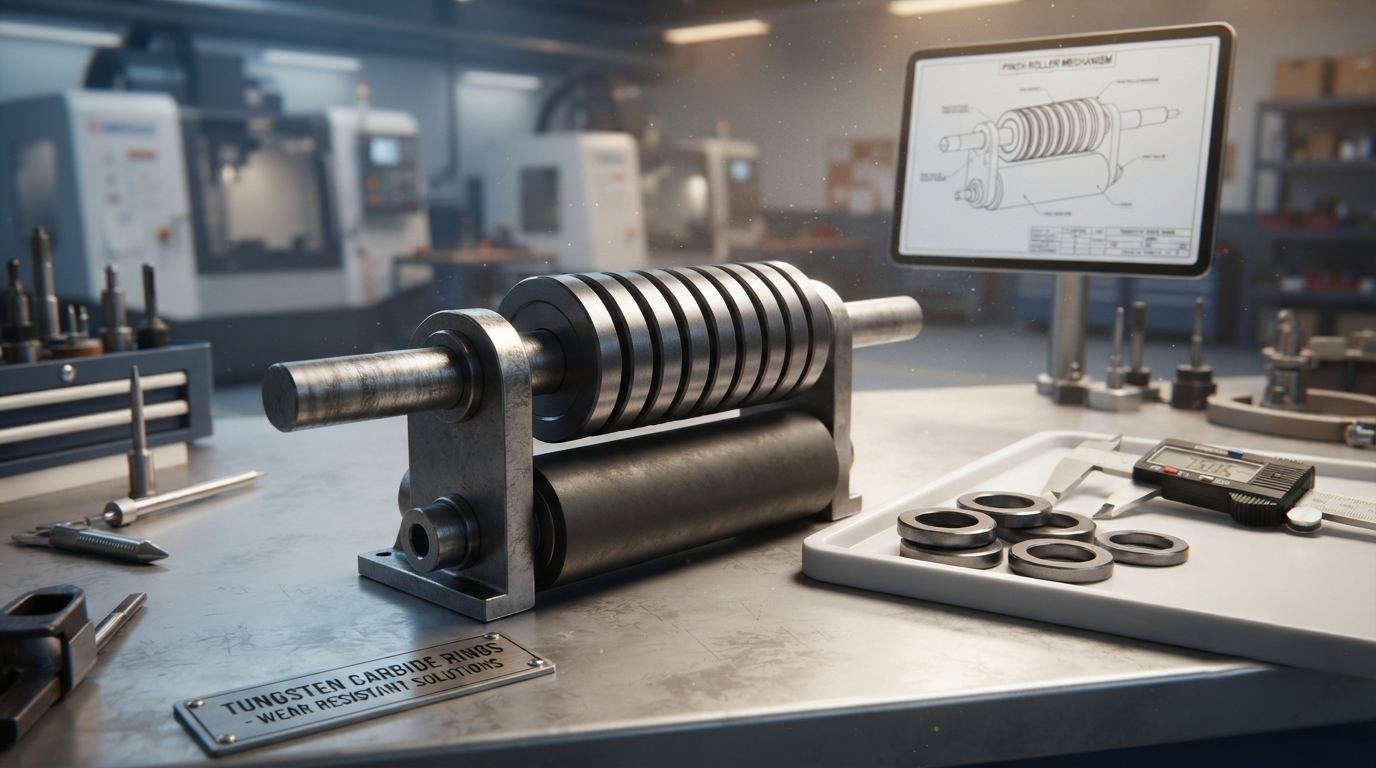
Within this changing production environment, Tungsten Carbide Rings and Pinch Roller systems continue to attract attention as important components in wire rod, bar, and other high-speed rolling applications.
The two technologies perform very different functions. Tungsten Carbide Rings are primarily used where wear resistance, dimensional accuracy, and groove stability are required, while a Pinch Roller controls the movement, gripping, speed, and tension of material as it travels through a production line.
For rolling-mill operators, the performance of these components can directly influence product consistency, equipment availability, maintenance frequency, and overall production efficiency.
Rolling Mills Face Greater Pressure for Consistent Production
Modern rolling plants are expected to produce large volumes of material while maintaining narrow dimensional tolerances.
Higher line speeds can increase productivity, but they also place additional stress on rolling components. Continuous exposure to hot steel, abrasive scale, cooling water, vibration, and mechanical pressure can accelerate wear.
Traditional roll materials may require more frequent servicing in demanding positions. This has encouraged the use of advanced materials such as cemented tungsten carbide in critical rolling applications.
At the same time, material-handling systems must keep pace with faster production.
That is where the Pinch Roller becomes essential.
Without controlled material movement, even a well-performing rolling stand can experience problems downstream.
Tungsten Carbide Rings Gain Importance in High-Wear Applications
Tungsten Carbide Rings are produced from cemented carbide, a composite material containing hard tungsten carbide particles held together by a metallic binder.
The material structure gives carbide rings a combination of:
- High hardness
- Strong wear resistance
- Compressive strength
- Dimensional stability
- Resistance to abrasive contact
These characteristics make carbide rings especially useful in rolling positions where the groove profile must remain consistent over extended production periods.
They can be applied in intermediate, pre-finishing, finishing, and sizing operations depending on mill design.
Carbide Grade Selection Becomes a Critical Engineering Decision
One important industry consideration is that not every carbide grade performs the same way.
The properties of Tungsten Carbide Rings vary according to carbide grain size, binder percentage, manufacturing quality, and final microstructure.
A harder grade may provide excellent resistance against abrasive wear. However, excessive hardness without sufficient toughness can create a higher risk of cracking under impact or unstable loading.
A tougher grade may withstand mechanical shock more effectively but could experience faster wear in highly abrasive environments.
For this reason, rolling-mill engineers increasingly evaluate several factors before choosing a ring grade.
These include:
- Steel grade being processed
- Rolling temperature
- Mill speed
- Rolling force
- Stand position
- Cooling conditions
- Product dimensions
- Groove geometry
The objective is to find a balance between hardness, toughness, wear resistance, and thermal performance.
Thermal Fatigue Remains a Major Concern
Temperature changes are one of the most demanding conditions experienced by Tungsten Carbide Rings.
During rolling, hot material transfers heat to the ring surface. Cooling water then rapidly removes that heat.
This repeated heating and cooling cycle can generate thermal stress.
Over time, microscopic cracks may develop on the working surface.
If operating conditions remain unfavorable, these cracks can grow and eventually cause chipping or larger ring failures.
Cooling-system performance therefore has a direct relationship with ring life.
Operators must monitor:
- Water flow
- Water pressure
- Nozzle alignment
- Cooling coverage
- Water quality
Uneven cooling can be particularly damaging because it creates different temperatures across the ring surface.
Pinch Roller Technology Supports High-Speed Material Control
While carbide rings focus mainly on rolling and sizing, the Pinch Roller is responsible for controlling material movement.
A typical pinch-roll arrangement uses opposing rollers that contact the moving rod or bar.
Controlled pressure between the rollers produces enough traction to guide the material through the required section.
The system may be used to:
- Control line speed
- Maintain stable tension
- Guide material
- Support head-end movement
- Control tail-end movement
- Feed laying or coiling systems
- Stabilize material between process stages
This function becomes increasingly important as rolling speed rises.
Speed Synchronization Becomes More Important at Higher Output
A Pinch Roller cannot operate independently from the rest of the production line.
Its rotational speed must remain properly coordinated with upstream and downstream equipment.
If the pinch roll operates too quickly, excessive pulling force may be applied to the material.
If it operates too slowly, material can become unstable or develop unwanted slack.
Both conditions can affect product handling.
Modern control systems may therefore regulate roller speed according to changing production conditions.
Accurate speed control helps maintain stable tension and improves material transfer between mill sections.
Pinch Force Can Determine Product Quality
Another major consideration is the pressure applied by the Pinch Roller.
Insufficient pressure may allow material to slip.
Possible consequences include:
- Unstable speed
- Inconsistent tension
- Poor material positioning
- Irregular downstream feeding
Excessive pressure creates a different group of problems.
These may include:
- Surface marking
- Material deformation
- Increased roller wear
- Higher bearing loads
- Additional drive stress
The best operating condition is achieved when enough force is applied to maintain traction without unnecessarily compressing the product.
Comparing Tungsten Carbide Rings and Pinch Roller Systems
| Performance Area | Tungsten Carbide Rings | Pinch Roller |
| Primary role | Rolling and forming | Material handling |
| Main requirement | Wear resistance | Reliable traction |
| Controls | Dimensions and profile | Speed and tension |
| Typical wear | Groove wear | Surface wear |
| Major failure risk | Cracking and chipping | Slippage and bearing problems |
| Important adjustment | Grade and groove | Gap and pressure |
| Key maintenance area | Cooling and ring surface | Bearings, alignment and drive |
The comparison shows that the two systems address different production challenges but ultimately support the same goal: stable and efficient mill operation.
Maintenance Teams Focus More on Early Wear Detection
Preventive maintenance remains one of the most effective ways to extend component life.
For Tungsten Carbide Rings, maintenance teams should watch for:
- Surface cracks
- Groove widening
- Edge chipping
- Abnormal wear
- Uneven cooling
- Incorrect mounting
Small changes in groove dimensions can influence finished-product accuracy.
Regular measurement can help operators determine when regrinding or replacement is required.
For the Pinch Roller, inspections should include:
- Roller surface condition
- Bearing temperature
- Shaft alignment
- Roll gap
- Drive vibration
- Pinch pressure
- Motor performance
Tracking these parameters can help identify developing problems before they interrupt production.
Manufacturers Focus on Longer Component Life
Rolling-mill component development increasingly centers on improving service life without compromising production reliability.
For carbide rings, improvements typically focus on material composition, microstructure, machining accuracy, and grade selection.
For pinch rolls, attention is placed on surface durability, drive response, automation, bearing reliability, and pressure control.
The broader objective is to increase operating time between maintenance events.
Reduced roll changes can provide several advantages, including lower maintenance labor, fewer production interruptions, more consistent dimensions, and improved equipment utilization.
Frequently Asked Questions
1. Why are Tungsten Carbide Rings used in rolling mills?
They provide high hardness, wear resistance, and dimensional stability in demanding rolling positions.
2. What is the primary purpose of a Pinch Roller?
It grips and controls moving material to manage speed, tension, and direction.
3. Are all carbide rings made from the same grade?
No. Carbide composition and binder content vary depending on application requirements.
4. What causes carbide ring wear?
Abrasive scale, rolling pressure, temperature cycles, improper cooling, and unsuitable operating conditions can increase wear.
5. Can Tungsten Carbide Rings develop cracks?
Yes. Thermal fatigue, mechanical overload, impact, and incorrect installation may contribute to cracking.
6. Why does a Pinch Roller slip?
Slippage may result from insufficient pressure, worn surfaces, contamination, or incorrect speed synchronization.
7. Can excessive pinch force affect product quality?
Yes. Too much pressure may mark or deform the material.
8. Why is cooling important for carbide rings?
Cooling controls surface temperature and helps reduce thermal stress during rolling.
9. How should carbide rings be selected?
Selection should consider steel grade, rolling speed, load, stand position, cooling, dimensions, and required toughness.
10. How can Pinch Roller life be improved?
Correct alignment, suitable pressure, regular bearing maintenance, clean roller surfaces, and accurate speed control can improve service life.