
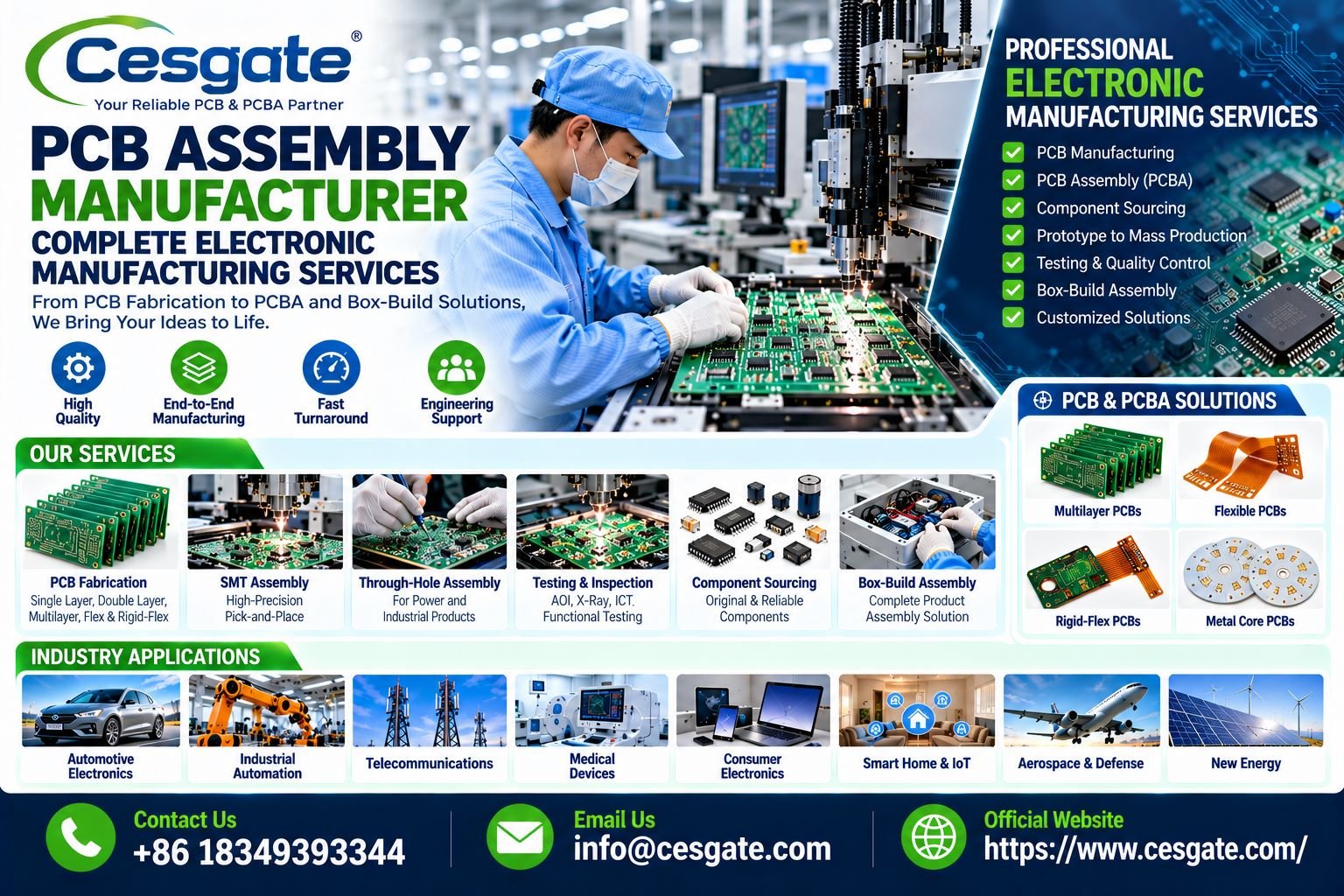
While component placement, soldering accuracy, and manufacturing efficiency remain important, product maintenance, repairability, and long-term technical support deserve equal consideration.
From industrial control systems to communication devices and smart electronics, manufacturers must consider how electronic products can be inspected, serviced, and maintained throughout their useful lives.
A professional pcb assembly manufacturer plays an important role in translating electronic designs into functional circuit board assemblies while supporting requirements that may influence future maintenance.
Meanwhile, electronic manufacturing services can connect component assembly, production testing, documentation, and product support within a coordinated manufacturing arrangement.
For original equipment manufacturers and product developers, planning for the complete product lifecycle can improve serviceability and reduce avoidable complications after production.
Why Product Lifecycle Planning Matters in Electronics
Electronic products operate in environments where component ageing, electrical stress, mechanical vibration, or unsuitable handling may affect performance.
Manufacturing quality can reduce certain risks, but it cannot eliminate every potential failure.
Product developers should therefore consider how equipment will be inspected and serviced when problems occur.
A circuit board designed without accessible testing points may be difficult to diagnose.
Similarly, unclear component identification can complicate repair work.
Lifecycle planning encourages cooperation between product designers, manufacturers, and maintenance professionals.
What Does a PCB Assembly Manufacturer Do?
A pcb assembly manufacturer installs electronic components onto printed circuit boards according to approved engineering instructions.
Manufacturing processes may include surface mount assembly, through-hole soldering, inspection, and electrical testing.
Depending on the supplier, additional capabilities may include prototype development, component procurement, and engineering assistance.
The manufacturer’s central responsibility is to produce assemblies that meet agreed specifications.
However, designers can also benefit from discussing future repair and testing requirements with manufacturing specialists.
Accessible component placement and suitable documentation can make subsequent maintenance more practical.
Understanding Electronic Manufacturing Services
Electronic manufacturing services, commonly abbreviated as EMS, refer to outsourced manufacturing activities supporting the production of electronic products.
Depending on the provider, these services may include circuit board assembly, material procurement, testing, box-build assembly, and selected product-support activities.
EMS arrangements allow businesses to work with specialist manufacturing providers rather than managing every production operation internally.
However, the precise scope varies between companies.
Some providers focus on assembly, while others offer broader integration services.
Customers should confirm the services included before establishing a manufacturing agreement.
Designing Circuit Boards for Easier Maintenance
Repairability begins during the product design stage.
Engineers can consider how components will be accessed, identified, and inspected after assembly.
For example, clearly labelled connectors can help technicians understand electrical connections.
Appropriately placed test points may support troubleshooting and diagnostic procedures.
Modular designs can sometimes simplify the replacement of individual functional sections.
However, serviceability must be balanced against product dimensions, electrical performance, safety, and manufacturing costs.
Not every circuit can be made fully repairable.
The objective is to introduce practical maintenance considerations without compromising essential product requirements.
Why Production Testing Should Consider Real Applications
Manufacturing inspection helps identify defects, but product developers should also define the intended operating conditions.
An electronic assembly may pass basic electrical checks while requiring additional verification for its specific application.
For example, an industrial monitoring device may need evaluation of communication functions, sensor inputs, and power behaviour.
Testing requirements should be defined through engineering specifications.
Appropriate acceptance criteria help manufacturers and customers understand the expected performance of completed assemblies.
PCB Manufacturing and Lifecycle Support Responsibilities
| Manufacturing Activity | Primary Purpose | Lifecycle Consideration |
| Component Selection | Meet electrical design requirements | Replacement component availability |
| PCB Assembly | Create functional electronic assemblies | Accessibility for inspection |
| Production Testing | Verify specified performance | Diagnostic reference information |
| Product Documentation | Record technical specifications | Maintenance and troubleshooting |
| Engineering Changes | Update approved product designs | Compatibility with existing products |
| Repair Assessment | Evaluate suitable failed assemblies | Restoration feasibility |
These considerations support a more complete approach to electronics manufacturing.
Managing Component Obsolescence
Electronic components may become difficult to source or be discontinued during a product’s service life.
This can create challenges for manufacturers supporting equipment that remains in operation.
Businesses should identify components with limited sourcing options and evaluate suitable alternatives where practical.
However, replacement components must be technically assessed.
Even components with similar functions may differ in electrical characteristics, packaging, software compatibility, or operating requirements.
An approved engineering change process can help manage these differences.
Product developers should maintain accurate records of component revisions and permitted substitutions.
How Repair Feedback Can Improve Product Design
Information collected from repair assessments can provide useful insights into product performance.
Repeated failures in a particular circuit area may indicate a need for further engineering investigation.
However, a failure pattern does not automatically establish the original cause.
Engineers may need to consider design conditions, manufacturing variation, environmental exposure, and operating practices.
Documented feedback helps teams evaluate whether corrective action is appropriate.
Possible improvements may involve component selection, circuit protection, mechanical support, or revised inspection procedures.
This creates a connection between manufacturing experience and product development.
Choosing an EMS Partner for Long-Term Product Support
Electronics companies should evaluate manufacturing partners according to both production capability and relevant lifecycle requirements.
Important considerations include:
- Technical Documentation: Ability to follow and manage approved manufacturing instructions.
- Testing Capabilities: Suitable inspection and functional verification processes.
- Engineering Communication: Clear procedures for resolving technical questions.
- Change Management: Controlled handling of approved revisions.
- Material Management: Appropriate procurement and component records.
- Service Scope: Clearly defined responsibilities for repair-related support.
A provider offering extensive manufacturing capabilities may not necessarily provide repair services.
These responsibilities should be confirmed before entering a commercial agreement.
Frequently Asked Questions (FAQs)
1. What is a PCB assembly manufacturer?
A PCB assembly manufacturer produces populated circuit boards by installing and connecting electronic components according to approved designs.
2. What are electronic manufacturing services?
Electronic manufacturing services involve outsourced electronics production activities, potentially including assembly, procurement, testing, and product integration.
3. Why is PCB repairability important?
Repairability can support fault diagnosis, component replacement, and maintenance when the product design and safety requirements permit servicing.
4. Can EMS providers support products after manufacturing?
Some providers offer selected repair, engineering, or product-support services, although capabilities and contractual responsibilities vary.
5. How can companies improve electronic product reliability?
They can use appropriate engineering design, suitable components, controlled manufacturing processes, defined testing, and documented feedback from product operation.
Media Contact
Department: PCB Assembly and Electronics Manufacturing Enquiries
Business Enquiries: PCB Assembly Manufacturing, Electronic Manufacturing Services, Custom PCB Production, OEM Electronics and Circuit Board Solutions.
Phone: +86 18349393344
Email: info@cesgate.com
Official Website: https://www.cesgate.com/