From medical seals and electronic protection parts to automotive gaskets and consumer products, silicone components are used wherever long-term reliability matters. Two important manufacturing approaches for producing these components are Silicone Compression Molding and low volume silicone molding.
Although both processes manufacture silicone parts, they are usually selected for different production requirements. Silicone compression molding is valued for its relatively straightforward tooling, material versatility, and ability to manufacture complex rubber components. Low volume silicone molding focuses on producing smaller quantities economically, making it particularly useful for prototypes, specialised products, pilot production, and products with limited market demand.
Understanding how these methods work helps manufacturers select a process based on quantity, design complexity, material requirements, tooling budget, and product lifecycle.
What Is Silicone Compression Molding?
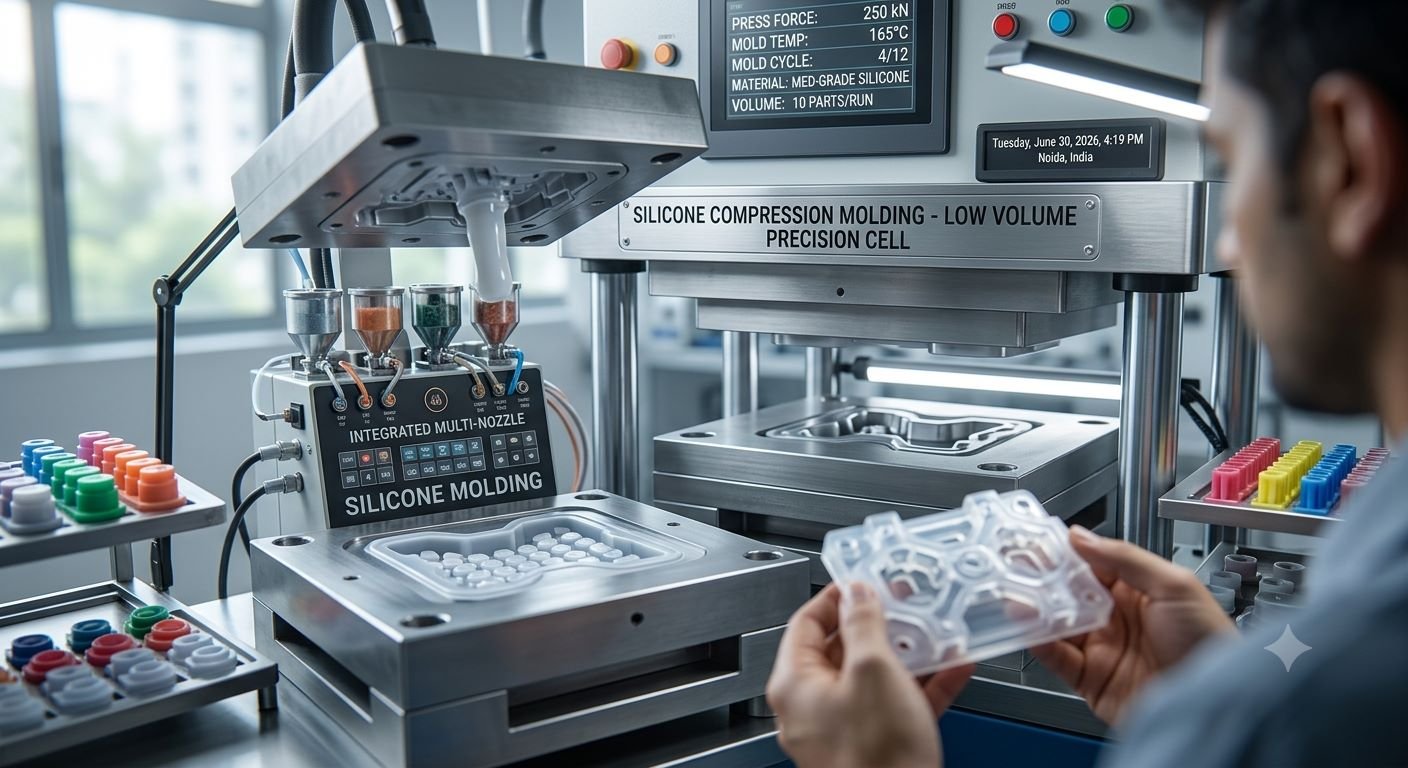
Silicone Compression Molding is a manufacturing process in which a measured quantity of uncured silicone material is placed inside a heated mould cavity. The mould is then closed under controlled pressure, forcing the silicone to flow and fill the required component geometry.
Heat and pressure allow the silicone to cure into its final shape. After sufficient curing time, the mould opens and the completed component is removed. Depending on the design, minor finishing processes such as flash removal, inspection, or secondary curing may follow.
A typical compression molding cycle involves:
- Preparing the required silicone compound.
- Measuring or cutting the appropriate material quantity.
- Placing the silicone inside the mould cavity.
- Closing the mould and applying pressure.
- Heating the material for controlled curing.
- Opening the mould and removing the component.
- Trimming excess material when required.
- Inspecting the finished part for dimensional and visual quality.
Because of its practical production setup, compression molding can accommodate many silicone component designs.
Why Manufacturers Choose Silicone Compression Molding
One major advantage of Silicone Compression Molding is tooling simplicity compared with some highly automated molding processes. This can help manufacturers reduce initial tooling investment, especially when expected production quantities do not justify complicated production systems.
Other benefits include:
- Suitable for various silicone compounds
- Effective for thick or relatively large components
- Lower tooling complexity for many designs
- Good dimensional repeatability
- Ability to manufacture detailed shapes
- Excellent material performance
- Suitable for both specialised and general-purpose components
Compression molding is particularly attractive when the component geometry, production quantity, and project budget favour a flexible manufacturing approach.
Understanding Low Volume Silicone Molding
Low volume silicone molding refers to silicone manufacturing specifically planned for relatively small production quantities. Rather than investing heavily in tooling and automation designed for hundreds of thousands or millions of pieces, manufacturers optimise the process for shorter production runs.
Low-volume manufacturing may be needed for dozens, hundreds, or several thousand components depending on the project.
Typical applications include:
- Functional prototypes
- Engineering validation components
- Medical device development
- Custom industrial seals
- Replacement components
- Pilot production
- Limited-edition consumer products
- Specialised electronic components
- Product testing
- Pre-production market evaluation
This approach gives companies greater flexibility before committing to large-scale manufacturing.
How Low Volume Silicone Molding Supports Product Development
Product development often involves repeated testing and design improvement. Ordering extremely large quantities before a component has been properly validated can create unnecessary inventory and financial risk.
With low volume silicone molding, engineering teams can manufacture production-quality components in smaller batches. These parts can then be evaluated for fit, sealing ability, mechanical performance, temperature resistance, appearance, and real-world functionality.
For example, a company developing a silicone gasket may first manufacture a limited batch. Engineers can install those gaskets into actual assemblies and monitor their performance before approving the design for larger production.
This process helps identify design problems earlier and provides valuable manufacturing feedback.
Silicone Compression Molding vs Low Volume Silicone Molding
Although the two terms are connected, they describe different aspects of manufacturing.
| Factor | Silicone Compression Molding | Low Volume Silicone Molding |
| Main focus | Molding process | Production quantity strategy |
| Production volume | Small to large depending on project | Primarily small batches |
| Tooling | Generally straightforward | Usually optimised for affordability |
| Ideal use | Silicone components and rubber parts | Prototypes and limited production |
| Flexibility | High | Very high |
| Initial investment | Often moderate | Designed to control initial cost |
| Product changes | Possible with tooling considerations | Particularly suitable for evolving designs |
In fact, compression molding may itself be used as part of a low-volume manufacturing strategy.
Materials Used in Silicone Molding
Selecting the correct silicone compound is just as important as choosing the manufacturing process.
Silicone materials may be formulated for different operating environments, including high temperatures, outdoor exposure, electrical insulation, repeated compression, and contact with certain chemicals.
Depending on project requirements, manufacturers may consider:
- High-temperature silicone
- Food-contact silicone
- Medical-grade silicone
- Electrically insulating silicone
- Flame-resistant silicone
- General-purpose silicone rubber
- Specially coloured silicone compounds
Material selection should be based on application requirements rather than price alone. Hardness, tensile strength, elongation, compression set, operating temperature, certification requirements, and environmental exposure can significantly influence performance.
Important Design Considerations
Good part design improves both manufacturing efficiency and finished-product quality.
When designing components for Silicone Compression Molding, engineers should consider wall thickness, draft angles, parting lines, flash locations, dimensional tolerances, surface finish, and undercuts.
Extremely tight tolerances can increase manufacturing difficulty and cost. Wherever possible, dimensions should reflect the actual functional requirement rather than unnecessarily restrictive specifications.
Designers should also consider how the component will be removed from the mould. Flexible silicone makes demolding easier than many rigid materials, but complex undercuts and delicate features still require careful engineering.
Industries Using Silicone Molded Components
Silicone molding is used across numerous sectors because silicone maintains useful properties under demanding operating conditions.
Common industries include:
- Automotive manufacturing
- Medical equipment
- Electrical and electronics
- Industrial machinery
- Household appliances
- Food-processing equipment
- Consumer products
- Lighting systems
- Telecommunications
- Aerospace-related applications
Typical products include seals, diaphragms, protective covers, keypads, vibration dampers, plugs, grommets, O-rings, insulation components, and custom gaskets.
How to Choose the Right Manufacturing Process
Selecting between production approaches requires more than comparing unit prices.
Manufacturers should evaluate:
- Expected annual quantity
- Required silicone material
- Component dimensions
- Part complexity
- Tolerance requirements
- Tooling budget
- Development timeline
- Future design changes
- Regulatory requirements
- Expected product lifecycle
For an evolving product with uncertain demand, low volume silicone molding may reduce financial exposure. For established components requiring reliable molded silicone production, Silicone Compression Molding may provide an effective balance between tooling investment and manufacturing capability.
Frequently Asked Questions
What is Silicone Compression Molding?
Silicone compression molding uses heat and pressure to cure silicone material inside a mould cavity and create a finished component.
Is compression molding suitable for small quantities?
Yes. Its relatively straightforward tooling can make compression molding practical for prototypes and smaller production runs.
What is low volume silicone molding?
It is a manufacturing approach designed to produce silicone components in relatively limited quantities without requiring large-scale production investment.
When should low volume molding be considered?
It is useful for prototypes, product testing, pilot production, specialised parts, replacement components, and products with uncertain demand.
Can low volume silicone parts be functional?
Yes. Properly manufactured parts can be fully functional and suitable for engineering evaluation or end-use applications.
What products can be compression molded?
Examples include gaskets, seals, keypads, diaphragms, plugs, protective covers, grommets, and various custom silicone components.
Can silicone withstand high temperatures?
Many silicone formulations offer excellent temperature resistance, although the exact operating range depends on the selected material grade.
Is silicone suitable for electrical applications?
Certain silicone compounds provide strong electrical insulation properties and are widely used in electronics and electrical equipment.
How important is mould design?
Mould design strongly influences dimensions, surface quality, flash, manufacturing efficiency, demolding, and overall part consistency.
Which process is best for prototypes?
Low volume silicone molding is often attractive for functional prototypes because manufacturers can produce smaller batches while controlling tooling investment.