
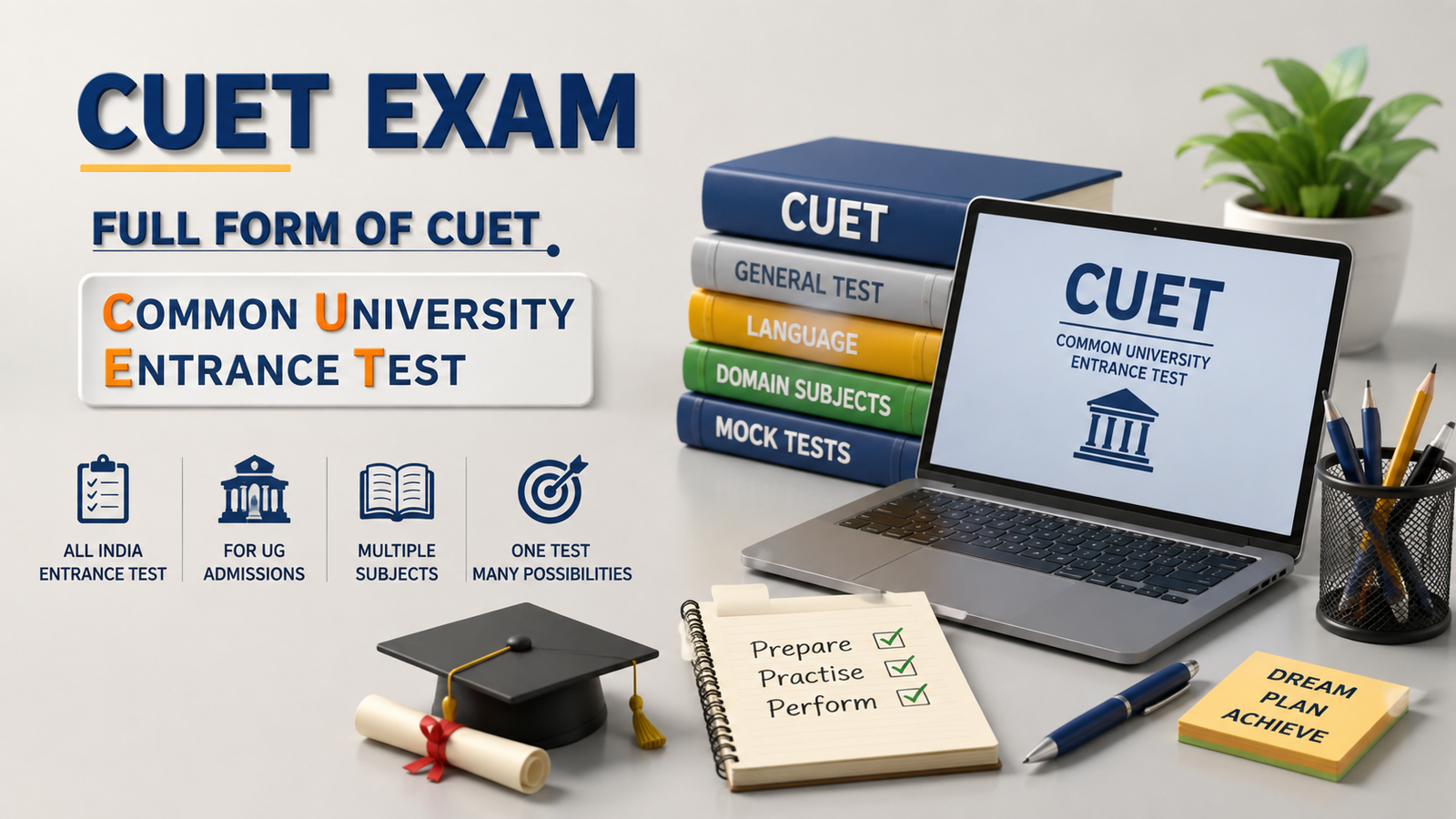
Students planning to enter undergraduate programmes at leading Indian universities frequently come across the CUET exam. It has become an important part of the university admission process, providing students with a common entrance platform instead of requiring them to depend entirely on separate university-level examinations.
The full form of CUET is Common University Entrance Test. The examination is conducted by the National Testing Agency (NTA) for admission to undergraduate programmes offered by Central Universities and other participating State, Deemed and Private Universities.
Understanding how CUET works, its purpose, subject selection and preparation strategy can help students approach university admission with greater confidence.
What Is the Full Form of CUET?
The full form of CUET is Common University Entrance Test.
CUET was introduced to create a more standardised admission process for students seeking entry into participating universities. Instead of students having to navigate several unrelated entrance examinations, CUET provides a common testing platform through which candidates can apply to multiple institutions.
For undergraduate admission, the examination is commonly referred to as CUET UG.
The National Testing Agency conducts CUET UG on behalf of participating universities. Students should remember that appearing for CUET does not automatically guarantee admission. Individual universities determine programme eligibility, required subjects, counselling procedures and admission criteria.
Why Is the CUET Exam Important?
The CUET exam provides students from different educational boards and regions with an opportunity to compete through a common assessment system.
Its major advantages include:
- A common entrance examination for participating universities
- Opportunities to apply to multiple institutions
- Reduced dependence on Class 12 board percentages alone
- A standardised assessment platform
- Access to Central, State, Deemed and Private participating universities
- Greater flexibility when exploring undergraduate programmes
The official CUET portal maintains separate lists of participating Central, State, Deemed, Private and other government institutions.
Students should always check whether their preferred university and programme participate in CUET before selecting subjects.
Who Conducts the CUET Exam?
The National Testing Agency (NTA) conducts the CUET examination.
NTA is an autonomous testing organisation established to conduct entrance examinations for admission and fellowship in higher educational institutions. Its responsibilities include examination administration, test delivery and assessment.
For CUET UG 2026, NTA conducted the examination in Computer-Based Test mode for undergraduate admissions for the 2026–27 academic session.
Understanding the CUET Admission Process
Knowing the full form of CUET is only the beginning. Students should understand how the examination fits into the overall admission process.
A typical journey involves:
- Identifying the desired course and universities
- Checking university-specific eligibility requirements
- Selecting appropriate CUET subjects
- Completing the NTA application
- Downloading the examination documents when released
- Appearing for the required test papers
- Checking the CUET scorecard
- Applying through the admission or counselling process of the chosen universities
- Completing document verification and admission formalities
One of the most important steps is choosing the correct subjects. Different degree programmes can require different CUET subject combinations.
CUET Exam vs Traditional University Entrance Tests
| Factor | CUET Exam | Separate University Entrance Test |
| Examination platform | Common entrance platform | Institution-specific |
| Universities | Multiple participating institutions | Usually one institution |
| Application strategy | Can support several university choices | Separate process |
| Assessment | Standardised CUET testing | University-defined |
| Admission decision | Made by individual universities | Made by respective institution |
The CUET exam therefore simplifies parts of the entrance process, but candidates still need to carefully research each university’s admission requirements.
How to Choose CUET Subjects
Subject selection should never be based only on what appears easy.
Students should first shortlist their preferred universities and undergraduate programmes. They should then verify the subject requirements specified by those institutions.
Check Course Eligibility First
Suppose a student wants to pursue Economics, Commerce, Science or Languages. The required CUET papers may vary considerably between programmes and universities.
Before submitting an application, check:
- Programme eligibility
- Required domain subjects
- Language requirements
- Accepted subject combinations
- Class 12 eligibility conditions
- University-specific admission rules
Important Preparation Tip
Never assume that one university’s subject requirements automatically apply to another. The safest approach is to verify the latest programme information directly through the university and official CUET websites.
How to Prepare for the CUET Exam
Effective CUET preparation requires consistency rather than simply studying for long hours.
Start by understanding the syllabus for every selected paper. NTA publishes CUET syllabus information on the official portal.
Students can improve preparation by following these steps:
- Study the official syllabus carefully.
- Identify strong and weak chapters.
- Create a realistic daily timetable.
- Strengthen important concepts before attempting difficult questions.
- Practise objective-type questions regularly.
- Attempt mock tests under timed conditions.
- Analyse mistakes after every practice test.
- Revise important concepts frequently.
- Avoid starting too many new topics immediately before the examination.
Time management is especially important. Knowing the answer is useful only when you can identify and solve questions efficiently under examination conditions.
Common Mistakes Students Should Avoid
Many candidates lose valuable preparation time because of avoidable mistakes.
Common problems include:
- Selecting subjects without checking course eligibility
- Ignoring official NTA notifications
- Depending entirely on coaching notes
- Taking mock tests without reviewing mistakes
- Studying every topic equally despite different weaknesses
- Leaving revision until the final few days
- Assuming CUET registration itself equals university registration
- Forgetting to check individual university admission portals
Students should rely primarily on official CUET and university information whenever examination or admission rules are involved.
Frequently Asked Questions About CUET
1. What is the full form of CUET?
The full form of CUET is Common University Entrance Test.
2. What is the CUET exam used for?
CUET scores are used for admission to undergraduate programmes at participating Central, State, Deemed, Private and other participating universities or institutions.
3. Who conducts the CUET exam?
The National Testing Agency conducts CUET UG.
4. Is CUET only for Central Universities?
No. Apart from Central Universities, participating State, Deemed, Private and other institutions may also use CUET scores.
5. Is CUET compulsory for every university in India?
No. Students should check the admission policy of the specific university and course they want to join.
6. Can Class 12 students appear for CUET?
Students seeking undergraduate admission can apply subject to the eligibility conditions prescribed for the examination and their chosen universities.
7. Can one CUET score be used for multiple universities?
CUET provides a common platform for participating universities, but candidates must satisfy each institution’s individual admission requirements.
8. How should I select CUET subjects?
Select subjects according to the eligibility and subject combination required by your preferred courses and universities.
9. Is board exam preparation enough for CUET?
Strong school-level concepts provide a good foundation, but students should also understand the CUET syllabus, question style and practise timed mock tests.
10. Where can students get official CUET updates?
Students should regularly check the official NTA CUET website for notifications, syllabus, participating universities, scorecards and examination updates.