
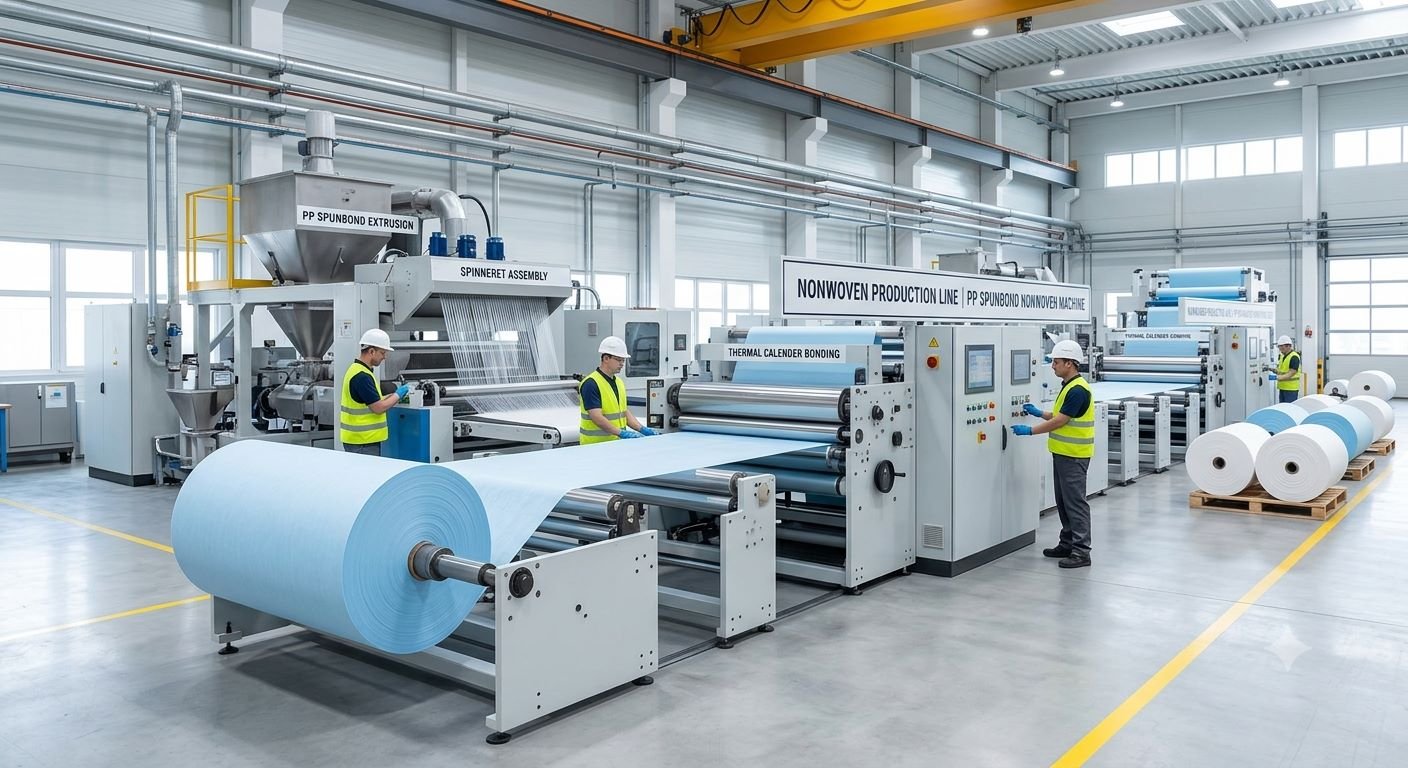
The global demand for lightweight, durable, hygienic, and cost-effective fabric materials has made nonwoven technology increasingly important across multiple industries. From medical masks and disposable gowns to agriculture covers, furniture materials, shopping bags, and hygiene products, nonwoven fabrics are now part of everyday manufacturing.
At the centre of this development is the Nonwoven Production Line, a coordinated manufacturing system designed to convert polymer raw materials into continuous nonwoven fabric efficiently. Among the most widely adopted technologies is the PP Spunbond Nonwoven Machine, which uses polypropylene to create strong, breathable, and versatile spunbond fabric.
Understanding how these systems work can help manufacturers select appropriate equipment, improve production efficiency, and maintain consistent fabric quality.
Understanding a Modern Nonwoven Production Line
A Nonwoven Production Line is more than a single machine. It consists of interconnected processing equipment responsible for polymer feeding, melting, extrusion, filament formation, web laying, bonding, cooling, winding, and sometimes cutting.
Unlike traditional textile manufacturing, nonwoven production normally eliminates spinning yarn and weaving or knitting fabric. Fibres or filaments are formed and bonded directly into a fabric-like sheet.
This streamlined approach offers several advantages:
- Faster continuous manufacturing
- Reduced dependence on traditional textile processes
- Flexible fabric weights and widths
- High production capacity
- Consistent material properties
- Suitability for disposable and industrial applications
Manufacturers can configure production systems according to their target GSM, fabric width, output capacity, application, and required bonding technology.
What Makes a PP Spunbond Nonwoven Machine Important?
A PP Spunbond Nonwoven Machine primarily processes polypropylene granules into continuous filaments. Polypropylene remains popular because it is lightweight, chemically resistant, relatively economical, and suitable for many disposable and reusable applications.
How the Spunbond Process Works
Polypropylene granules first enter a feeding and extrusion system. The polymer is heated until it becomes molten and is then filtered before reaching the spinneret.
Thousands of extremely fine continuous filaments emerge from microscopic openings. These filaments are cooled, stretched, and distributed onto a moving forming belt.
The loose filament web then passes through heated calendar rollers. Controlled heat and pressure bond the fibres together, creating finished spunbond nonwoven fabric.
Finally, the fabric passes through winding equipment before being prepared for storage, conversion, printing, lamination, or other downstream processes.
Why Process Control Matters
Small variations in polymer temperature, air pressure, extrusion speed, filament distribution, or calendar temperature can influence fabric strength, thickness, softness, appearance, and uniformity.
Modern control systems therefore help operators monitor operating parameters and maintain stable production conditions.
Major Components of a Nonwoven Manufacturing System
Although machine configurations differ between manufacturers, an industrial Nonwoven Production Line generally incorporates several essential sections.
The raw material feeding system controls the delivery of polypropylene granules and optional additives. Extruders melt and homogenise the material before filtration removes unwanted particles.
The spinning system forms continuous filaments, while stretching equipment reduces filament diameter and influences strength.
A forming system distributes these fibres evenly over a conveyor. Thermal bonding equipment subsequently gives the material its final mechanical stability.
The final section typically includes cooling, edge trimming, tension control, winding, and roll handling.
Automation can connect these processes through PLC and touchscreen interfaces, allowing operators to monitor speed, temperature, pressure, alarms, and production conditions from a central location.
Spunbond Machine Configurations
Different applications require different fabric structures. Manufacturers can therefore select equipment according to their desired performance.
| Configuration | Typical Structure | Common Application |
| S | Single spunbond layer | Packaging and agriculture |
| SS | Double spunbond layer | Hygiene and household materials |
| SSS | Triple spunbond layer | Medical and premium applications |
| SMS | Spunbond-meltblown-spunbond | Protective and hygiene materials |
| SMMS | Multi-layer composite | Medical and filtration applications |
A standard PP Spunbond Nonwoven Machine may be suitable where mechanical strength and economical production are the primary priorities. Composite systems become more valuable when manufacturers require specialised barrier or filtration characteristics.
Key Factors When Selecting Nonwoven Equipment
Purchasing production machinery should be based on actual manufacturing requirements rather than output capacity alone.
Manufacturers should first determine the intended fabric application. A machine producing agricultural material may require different specifications from equipment manufacturing hygiene or healthcare fabrics.
Production width is another critical consideration because it affects both finished roll dimensions and overall plant capacity.
GSM range should also match the target market. Equipment capable of maintaining stable lightweight fabric production requires precise filament formation and web distribution.
Energy consumption, automation level, maintenance accessibility, spare-part availability, operator training, installation support, and technical documentation should also be evaluated before investment.
Applications of PP Spunbond Nonwoven Fabric
The versatility of polypropylene spunbond material explains its widespread industrial use.
In healthcare, it may be converted into protective clothing components, medical covers, shoe covers, caps, and hygiene-related products.
Agricultural applications include crop protection covers, weed-control fabrics, and nursery materials.
The furniture industry uses nonwoven fabric for mattress backing, upholstery support, protective layers, and packaging.
Other applications include reusable shopping bags, filtration support layers, industrial wrapping, cable coverings, home textiles, and construction materials.
This diversity enables a properly configured Nonwoven Production Line to serve multiple downstream markets.
Improving Production Efficiency and Fabric Quality
Operating efficiency depends on more than machine speed. Stable processing usually produces better commercial results than continuously running equipment at maximum theoretical output.
Manufacturers should monitor extrusion temperatures, polymer quality, filtration conditions, airflow, filament stretching, web uniformity, bonding temperatures, line speed, tension, and winding accuracy.
Preventive maintenance is equally important.
Regular inspection of extruders, spinnerets, heaters, filters, motors, conveyors, pneumatic components, electrical systems, and calendar rollers can reduce unexpected interruptions.
Quality testing should evaluate parameters such as GSM consistency, tensile strength, elongation, width, roll appearance, bonding quality, and surface uniformity.
Sustainability and Material Efficiency
Modern nonwoven manufacturing increasingly focuses on reducing energy use and production waste.
Accurate dosing systems can minimise unnecessary raw-material consumption, while reliable web formation reduces defective fabric. Edge-trimming waste may also be recoverable depending on the production process and required product specifications.
Energy-efficient motors, temperature management, heat recovery concepts, and production monitoring systems can further improve plant efficiency.
For manufacturers, sustainability is therefore closely connected with process optimisation, material utilisation, equipment maintenance, and responsible production planning.
Frequently Asked Questions
1. What is a Nonwoven Production Line?
It is an integrated manufacturing system that converts polymer or fibre materials into nonwoven fabric without conventional weaving or knitting.
2. What does a PP Spunbond Nonwoven Machine produce?
It produces polypropylene spunbond fabric using continuous polymer filaments that are laid into a web and thermally bonded.
3. Which raw material is commonly used?
Polypropylene granules are the primary raw material used for PP spunbond production.
4. What does GSM mean?
GSM means grams per square metre and indicates fabric weight.
5. Can one machine produce different GSM fabrics?
Yes. The available GSM range depends on equipment design, operating settings, line speed, and production configuration.
6. What industries use spunbond fabric?
Healthcare, hygiene, agriculture, furniture, packaging, construction, filtration, and home textile industries commonly use it.
7. What is the difference between S and SS production lines?
An S line uses one spunbond beam, while an SS configuration normally uses two spunbond layers for improved fabric properties and production flexibility.
8. Why is fabric uniformity important?
Uniformity helps maintain consistent strength, weight, appearance, and downstream processing performance.
9. Is automation important in nonwoven manufacturing?
Yes. Automation helps operators control critical parameters, identify abnormalities, reduce manual adjustments, and improve production consistency.
10. How should manufacturers choose a machine supplier?
They should evaluate equipment quality, technical specifications, service capability, installation support, spare parts, training, energy efficiency, and long-term maintenance assistance.